
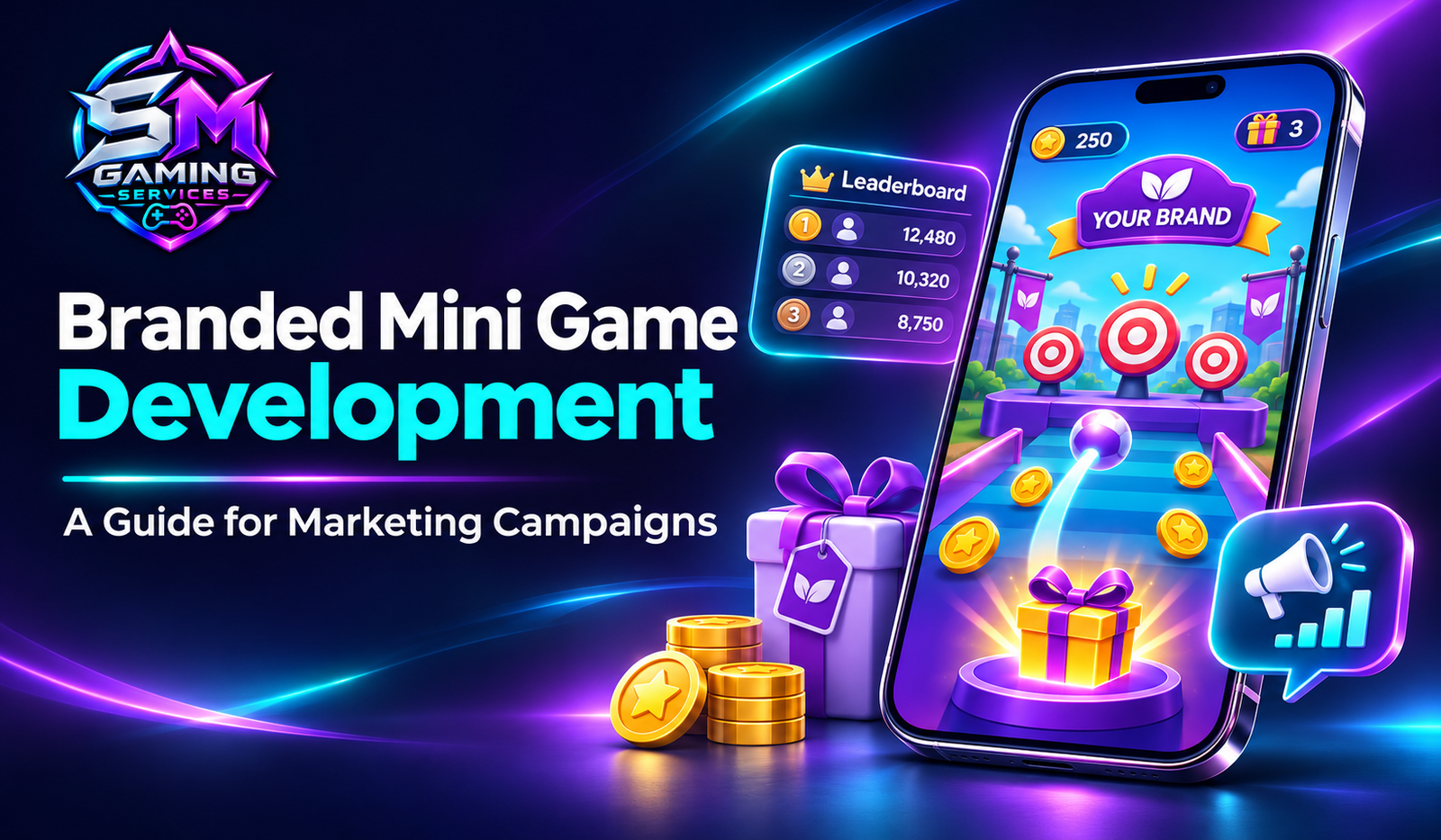
Getting someone to notice your marketing campaign is one challenge. Giving them a reason to participate is another. A short, enjoyable game can turn a passive impression into an interaction that introduces your product, communicates an offer, or encourages the next step.
Branded mini game development brings your identity, campaign message, and business objective into a simple playable experience. Think of a product matching challenge, a festival quiz, or a quick obstacle course featuring your brand’s mascot. The game gives people something to do while creating opportunities for meaningful engagement.
However, successful campaigns need more than attractive graphics and prizes. They need clear goals, suitable gameplay, reliable performance, and a measurement plan that connects participation with business outcomes.
This guide explains how businesses can use mini games for marketing campaigns, choose the right format, plan development, estimate costs, and evaluate results. Whether you are exploring your first campaign or reviewing an existing concept, the aim is straightforward: build an experience people understand quickly and give every interaction a clear marketing purpose.
What Is a Branded Mini Game?
A branded mini game is a short interactive experience designed around a company’s identity, products, or campaign message. Players complete a simple activity, such as answering questions, matching items, or collecting objects, while encountering relevant brand elements. Unlike a standalone entertainment product, its purpose supports a defined marketing objective. Businesses researching what are mini games should understand that short sessions and straightforward mechanics are common characteristics. Branding becomes useful when it shapes the experience meaningfully, helping players understand or remember something relevant about the business behind the campaign they encounter.
How Does a Marketing Game Work?
A typical campaign takes visitors from an advertisement, email, package, or event display to a playable page. Instructions explain the challenge, players interact, and the result introduces a relevant next step. That action might involve viewing a product, redeeming an offer, or requesting information. The strongest journeys connect each stage without making participation feel confusing or unnecessarily demanding for visitors.
- Entry point: An advertisement, email link, QR code, or website banner.
- Game: A short challenge connected to the campaign message.
- Result: A score, recommendation, achievement, or eligible reward.
- Next step: A relevant product page, offer, or enquiry form.
Why Use Games in a Marketing Campaign?
Branded games for marketing can give audiences an active role in a campaign instead of asking them only to watch or read. A thoughtful interaction can demonstrate a product benefit, introduce a collection, or make an event more memorable. Results depend on the audience, distribution, and execution; a game alone does not create demand. When planning Mini Games development, begin with the customer problem and campaign objective. Entertainment should help deliver the message, while the surrounding journey makes participation worthwhile and the next action easy to understand for interested players.
How Can Gameplay Support Product Discovery?
Imagine a skincare brand offering a short routine building challenge. Players select products for a fictional customer, receive feedback, and explore the matching collection afterward. This hypothetical example connects interaction with product understanding. The same principle can support food, fashion, travel, or software campaigns when the activity highlights a genuine customer decision rather than displaying unrelated logos throughout the experience.
- Introduce product features through decisions and feedback.
- Give event visitors an activity worth exploring.
- Encourage repeat participation when there is a meaningful reason.
- Direct interested players toward relevant information.
Which Game Formats Fit Different Marketing Goals?
The best format depends on what players should understand or do afterward. Quizzes suit knowledge and preference discovery, matching games can introduce product ranges, and collection challenges can reinforce a campaign theme. Before browsing Mini Games to play for inspiration, define the intended audience and available attention. A busy exhibition visitor needs a different experience from a returning loyalty customer. Choose mechanics that are easy to explain and appropriate for the channel. Original artwork helps, but a clear connection between gameplay and purpose matters more than decorative complexity or novelty.
| Game format | Suitable campaign goal | Hypothetical example | Useful measurement |
|---|---|---|---|
| Product matching | Introduce a collection | Match products with their uses | Completion and product clicks |
| Knowledge quiz | Explain product benefits | Answer questions about a new feature | Correct answers and next-step visits |
| Preference quiz | Support product discovery | Find a suitable travel package | Recommendation clicks |
| Collection challenge | Reinforce a launch theme | Collect ingredients for a new drink | Completed sessions and offer visits |
| Puzzle | Communicate a product story | Assemble an image revealing a launch | Completion and reveal views |
| Instant-win experience | Distribute promotional rewards | Reveal an eligible campaign offer | Valid claims and redemptions |
These examples illustrate possible campaign designs; they are not reported customer results.
How Do You Choose a Suitable Mechanic?
Start with the message, then choose an interaction that makes it easier to understand. A product comparison might suit a matching activity, while an educational campaign could use a quiz. Reviewing mini game ideas helps identify possibilities, but copying a popular mechanic without considering audience needs can produce plenty of activity with little commercial relevance or lasting value for participants.
- Choose one main interaction.
- Make the first action obvious.
- Match difficulty to the audience.
- Connect the result to a useful next step.
How Do You Plan and Build the Experience?
To understand how to create a branded mini game, treat development as a sequence of decisions rather than starting with animation. Define the objective, audience, mechanic, distribution, and measurement before expanding the feature list. This makes proposals easier to compare and reduces avoidable changes. Businesses evaluating game development services should request a playable prototype early, because written descriptions rarely reveal every usability issue. Approve the core experience before investing heavily in artwork, integrations, and rewards. A focused scope also helps teams protect the launch date and control campaign spending effectively.
Step 1: Define the Objective and Audience
Choose one primary outcome, such as product exploration, qualified enquiries, or offer redemption. Describe who should participate, where they will discover the campaign, and what motivates them. Set a measurable success criterion before production starts. This gives designers a practical brief and helps prevent entertaining features from distracting the team from the business result the campaign actually needs to achieve.
Step 2: Map the Complete Player Journey
Sketch the experience from the first campaign impression to the final action. Include the landing page, instructions, gameplay, result, and any optional form. Decide when users see rewards and what information they need beforehand. Remove unnecessary steps wherever possible. A clear journey helps expose friction before development makes those decisions more expensive and difficult to change during the production process.
Step 3: Prototype, Test, and Refine
Build a simple playable version and ask representative users to try it without coaching. Observe whether they understand the controls, complete the challenge, and recognize the intended message. Test the result screen as carefully as gameplay. Use these observations to refine difficulty and instructions before final artwork, integrations, and launch preparation consume the remaining production budget and available team time.
A practical campaign brief should include:
- Target audience and primary objective.
- Game mechanic and brand message.
- Distribution channels and supported devices.
- Reward rules and player journey.
- Tracking requirements and success measures.
- Deliverables, responsibilities, and approval dates.
Which Technology and Development Approach Should You Choose?
Browser delivery can make campaign access straightforward because players can open a link instead of installing a dedicated application. HTML5 mini game development commonly combines web technologies to deliver these experiences across supported browsers. However, compatibility and performance still require testing. When assessing HTML5 game development for brands, consider loading speed, controls, accessibility, hosting, and integration requirements together. The right approach depends on campaign complexity and distribution. A lightweight website game may suit a short promotion, while deeper application integration can require additional engineering, testing, and coordination across several teams. MDN
Should You Choose a Template or Custom Build?
The choice between custom vs white label mini games depends on how much differentiation and flexibility the campaign needs. A licensed template can suit familiar mechanics with limited changes. A custom build offers greater control over gameplay and integrations. Compare the actual licence, editing limits, ownership, support, and reuse rights before choosing either approach for your planned marketing campaign requirements.
| Decision factor | Adapted template or white label | Custom development |
|---|---|---|
| Gameplay | Based on existing mechanics | Designed around the brief |
| Visual changes | Depends on template capabilities | Defined within the project scope |
| Integrations | May need additional work | Can be planned into the architecture |
| Delivery | Can be quicker when changes are limited | Depends on design and development scope |
| Ownership | Governed by the licence | Governed by the development agreement |
| Reuse | Subject to licence and editing limits | Subject to ownership and third-party terms |
Confirm before approving the technical scope:
- Supported browsers and devices.
- Hosting responsibilities and traffic assumptions.
- Analytics and CRM requirements.
- Accessibility requirements.
- Maintenance, source access, and reuse rights.
How Can a Campaign Turn Players Into Leads?
Branded mini games generate leads when interested participants voluntarily share relevant details through a clear and worthwhile exchange. That might involve receiving a personalized recommendation, requesting a demonstration, or claiming an eligible offer. Gamification in marketing works best when the form follows naturally from the experience. Avoid collecting information simply because a game makes it possible. Ask only for details needed for the stated purpose, explain their use, and distinguish reward administration from optional marketing communications. Lead quality matters more than a large list of people attracted solely by prizes.
Where Should Registration Fit Into the Journey?
Place registration where its purpose becomes understandable. A player might finish a challenge before choosing whether to save a result or request further information. Some campaigns need eligibility checks earlier, but explain that requirement clearly. Test different journeys using qualified lead outcomes, because removing friction is useful only when the resulting enquiries remain relevant to the business and campaign objective.
- Keep forms proportionate to the next step.
- Explain what participants will receive.
- Make optional communication choices clear.
- Track valid enquiries separately from all submissions.
- Connect follow-up content to the player’s expressed interest.
What Determines the Development Budget and Timeline?
Branded mini game development cost depends on the work required, including gameplay, artwork, integrations, testing, and campaign operations. There is no reliable universal price without a defined scope. A simple adapted game and a custom experience with account integration are different projects. Teams asking how mini games make money should also distinguish direct game revenue from marketing value, such as qualified demand or attributable purchases. Budget for the complete campaign, including distribution and reward fulfilment. Development spending alone does not show whether the overall investment makes commercial sense for businesses.
| Cost component | Questions that affect the estimate |
|---|---|
| Gameplay | Is the mechanic existing, adapted, or newly designed? |
| Artwork and audio | Are original assets, animations, or multiple languages needed? |
| Integrations | Does the game connect to a CRM, account system, or product catalogue? |
| Rewards | Are codes, eligibility checks, or redemption systems required? |
| Quality assurance | Which devices, browsers, and traffic conditions need testing? |
| Operations | Who handles hosting, monitoring, support, and campaign closure? |
| Promotion | How will the campaign attract the intended audience? |
How Should You Request Comparable Proposals?
Give each supplier the same brief and ask for an itemized estimate. Separate essential requirements from optional features, then request milestones, dependencies, and acceptance criteria. Confirm whether hosting, revisions, analytics, and support are included. A useful proposal explains assumptions and exclusions clearly, allowing your team to compare delivery commitments instead of judging suppliers only by the final quoted project price.
- Request a delivery schedule tied to specific outputs.
- Identify approval deadlines and content dependencies.
- Clarify revision limits.
- Separate production fees from ongoing costs.
- Include contingency for unresolved requirements.
How Do You Measure Campaign Success and ROI?
Measure success against the objective established before launch, using a funnel from campaign visits to meaningful outcomes. Interactive marketing games can attract participation without generating incremental business value, so avoid treating play counts as proof of success. Define each event and denominator consistently. Businesses comparing mini games vs casual games should recognize that a campaign experience may prioritize a relevant action over prolonged play. Google Analytics supports interaction events and key events; configure these around campaign goals rather than collecting data without a clear reporting purpose or actionable measurement plan. developers.google.com
| Metric | Calculation | What it helps assess |
|---|---|---|
| Start rate | Unique starters ÷ eligible landing visitors × 100 | Whether the entry page encourages play |
| Completion rate | Unique completers ÷ unique starters × 100 | Whether players reach the intended result |
| Lead conversion rate | Valid leads ÷ unique starters × 100 | Whether participation leads to enquiries |
| Qualification rate | Qualified leads ÷ valid leads × 100 | Whether enquiries match the target audience |
| Redemption rate | Redeemed offers ÷ distributed valid offers × 100 | Whether offers are used |
| Cost per qualified lead | Total campaign cost ÷ qualified leads | Acquisition efficiency |
| Campaign ROI | (Incremental attributable gross profit − campaign cost) ÷ campaign cost × 100 | Financial return under the stated assumptions |
How Do You Calculate Financial Return?
Suppose a hypothetical campaign costs ₹200,000 and produces ₹300,000 in incremental attributable gross profit before campaign costs. Using the stated formula, ROI equals fifty percent. This is an illustration, not a forecast. Revenue alone would overstate return because fulfilment costs matter. Document attribution assumptions and use a comparison group when practical to estimate outcomes beyond normal customer purchasing behaviour patterns.
Useful tracking events could include:
- Game started.
- Game completed.
- Product recommendation viewed.
- Product link selected.
- Valid enquiry submitted.
- Offer redeemed.
Count repeat sessions separately from unique participants, and avoid counting the same commercial outcome more than once.
What Mistakes Can Weaken Campaign Performance?
The most common problems appear when the game becomes disconnected from the campaign. Complicated controls, slow loading, unclear rewards, and irrelevant forms can interrupt participation. Meanwhile, generous prizes may attract people who have little interest in the product. Even strong creative work needs a suitable distribution plan. When commissioning branded mini game development, review the complete experience through the eyes of a first visitor. They should understand what to do, why participation matters, and what happens afterward without needing a salesperson or lengthy explanation to guide them through every stage.
What Should You Check Before Launch?
Test the campaign on representative devices, browsers, and connection conditions. Check instructions, touch controls, form validation, tracking, reward handling, and the final destination. Review what happens when a player refreshes, loses connectivity, or submits twice. Assign owners for monitoring and support. A launch checklist is useful only when someone verifies each requirement and resolves the issues that testing actually reveals.
- Test the game inside the browsers used by campaign channels.
- Confirm readable text and usable controls on smaller screens.
- Provide sound controls and clear instructions.
- Verify valid reward codes and duplicate handling.
- Check analytics before paid promotion starts.
- Prepare the page shown after the campaign ends.
How Do You Choose the Right Development Partner?
Choose a promotional game development company by evaluating relevant work, delivery clarity, and its understanding of your marketing objective. Ask suppliers to explain how their proposed experience connects gameplay with the desired customer action. A portfolio is useful, but the discussion should also cover testing, measurement, ownership, and ongoing responsibilities. When comparing custom branded game development services, request evidence that matches your actual needs. A visually impressive project does not automatically demonstrate capability in CRM integration, campaign reporting, or reward operations. Confirm those requirements explicitly before approving the project scope.
What Questions Should You Ask a Supplier?
Ask who will own the source files, where the game will run, and how results will be measured. Request a demonstration on a typical target device, not just a development machine. Discuss changes, support, traffic assumptions, and campaign closure. The answers should become written commitments in the proposal, with clear responsibilities and acceptance criteria for the agreed deliverables and milestones.
- Can you show a relevant playable example?
- How will the mechanic support our campaign objective?
- Which integrations are included?
- How will testing and acceptance work?
- What can we reuse in future campaigns?
- Who handles support during the live promotion?
Final Thoughts
A useful branded game starts with a clear marketing purpose and gives people a simple reason to participate. Choose a mechanic that supports your message, make access straightforward, and connect the result with a relevant next step. Plan measurement, distribution, and operations alongside creative development. Start with a manageable experience, test it with representative users, and improve it using meaningful outcomes. If your business is exploring a campaign, contact us today to discuss your audience, objectives, and requirements, then turn that brief into a practical development plan with measurable goals.
Ready to turn your next marketing campaign into an interactive brand experience? Bring your campaign ideas to life with branded mini game development tailored to your audience and business goals. From product quizzes to engaging challenges, create meaningful opportunities for participation and product discovery. Contact us today to discuss your requirements and plan a game that supports your marketing objectives.
Frequently Asked Questions
Q1. What Is Branded Mini Game Development?
Ans. Branded mini game development is the process of creating short, interactive games around a company’s identity, products, or marketing message. These games use simple activities, such as quizzes, puzzles, or collection challenges, to encourage participation. Businesses can use them to introduce products, support promotional campaigns, or generate relevant enquiries. An effective branded game connects the activity with a clear customer benefit and business objective. For example, a product matching game could help shoppers explore a collection before directing them to suitable product pages.
Q2. How Do Brands Use Mini Games for Marketing Campaigns?
Ans. Brands use mini games for marketing campaigns by placing playable experiences on campaign websites, landing pages, or supported applications. People can discover them through advertisements, email links, social posts, or QR codes on packaging and event displays. Gameplay introduces the campaign message, while the result screen offers a relevant next step, such as exploring a product or redeeming an eligible offer. The format should match the objective: a quiz can explain product benefits, while a matching challenge can introduce a new collection.
Q3. Which Types of Mini Games Work Best for Brand Promotion?
Ans. The best mini game for brand promotion depends on the audience, campaign message, and desired action. Quizzes suit product education, matching games help introduce collections, and puzzles can reveal a launch or campaign story. Collection challenges may suit brands with recognizable products or characters. Choose a format people can understand quickly and play comfortably on their devices. The mechanic should reinforce the message, while the result leads naturally to a useful action. No single format performs best across every campaign.
Q4. How Much Does Branded Mini Game Development Cost?
Ans. Branded mini game development cost depends on gameplay complexity, artwork, integrations, testing, and support requirements. Adapting an existing template may require less work than creating original mechanics, although licensing and customization can affect the total. Features such as CRM connections, multiple languages, leaderboards, and reward management add scope. Request an itemized quotation based on a written brief. Include hosting, maintenance, promotion, and reward fulfilment in the overall campaign budget so you can evaluate the complete investment.
Q5. How Long Does It Take to Develop a Branded Mini Game?
Ans. Development time depends on the game’s scope, available assets, approval process, and technical requirements. Adapting a suitable template can be quicker than building a custom experience with original artwork and integrations. A realistic schedule should cover planning, prototyping, design, development, testing, and launch preparation. Ask your development partner for milestone dates and the assumptions behind them. Providing brand guidelines, campaign copy, reward details, and timely feedback helps reduce delays. Confirm the delivery schedule after the team reviews your complete requirements.
Q6. How Do Branded Mini Games Generate Leads?
Ans. Branded mini games generate leads by giving interested players a relevant reason to share their details. After completing a challenge, participants might request a product recommendation, book a demonstration, or claim an eligible offer. Keep forms short, explain how information will be used, and make optional marketing choices clear. The incentive should appeal to potential customers rather than only prize seekers. Measure valid submissions and qualified enquiries separately, because a large number of registrations does not necessarily indicate strong business interest.
Q7. Can Branded Mini Games Run Without an App Download?
Ans. Yes, browser-based branded mini games can run without requiring a dedicated app download. HTML5 mini game development uses web technologies to deliver playable experiences through supported browsers. Users can open a campaign link or scan a QR code to reach the game. However, browser delivery does not guarantee identical performance on every device. Developers should test loading speed, screen layouts, touch controls, and functionality across the intended devices and browsers, including browsers opened within social media applications.
Q8. How Do You Measure a Branded Mini Game Campaign’s Success?
Ans. Measure a branded mini game campaign against its original objective. Useful metrics include unique players, completion rate, product clicks, qualified leads, offer redemptions, and attributable purchases. Define each metric consistently and include development, promotion, hosting, and rewards in campaign costs. For financial evaluation, calculate ROI as incremental attributable gross profit minus campaign cost, divided by campaign cost, multiplied by 100. Document attribution assumptions carefully. Play counts show participation, while qualified actions and incremental business outcomes provide stronger evidence of marketing value.

2 Comments
[…] browser puzzles, mobile challenges, and branded campaign experiences. Businesses considering branded mini game development can use that coverage to frame an conversation. Request playable client examples, a defined […]
[…] branded mini game development connects the play experience to a campaign objective without overwhelming players with promotional […]