
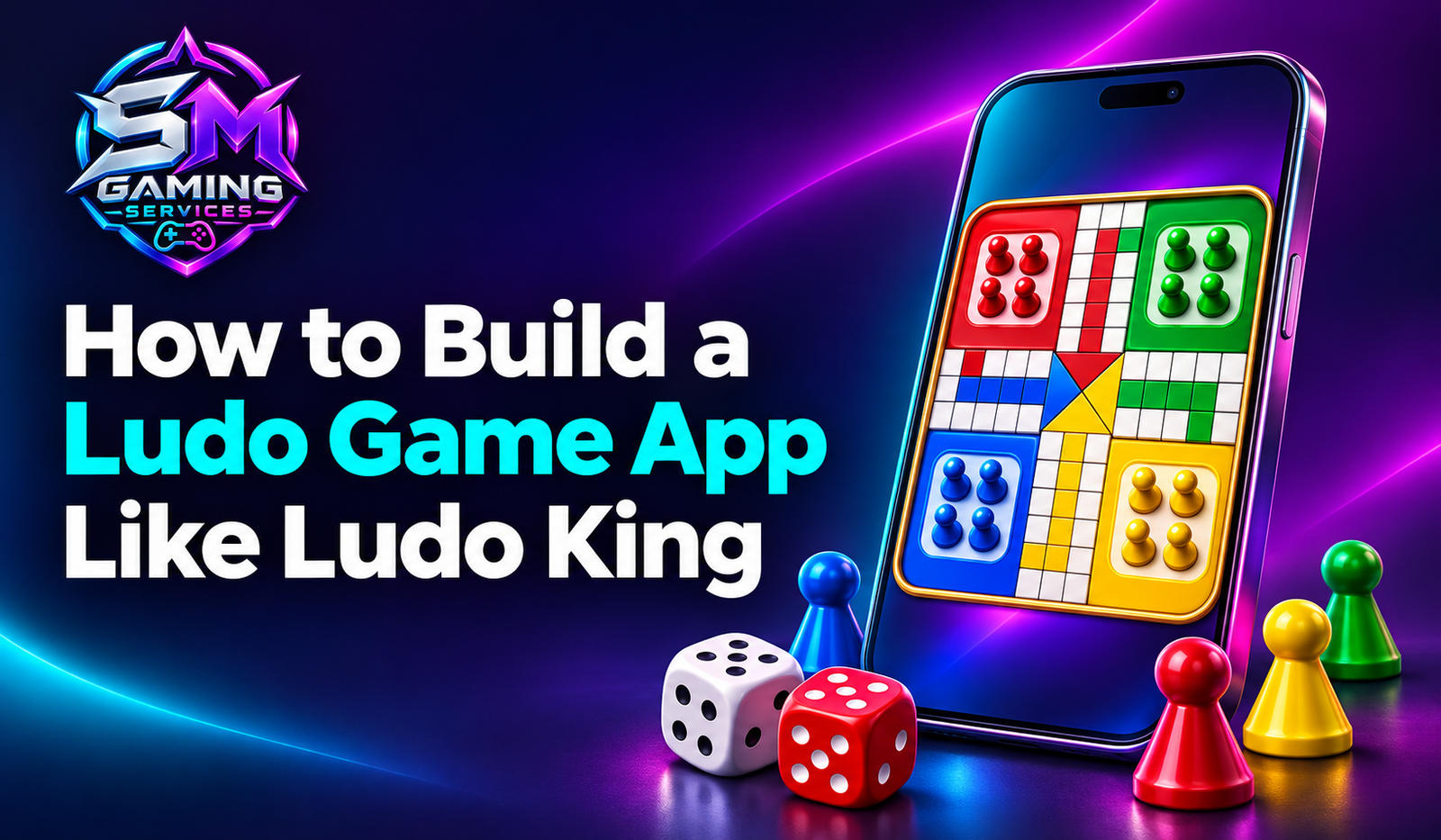
Ludo game app development starts with a familiar board game, but building an app people enjoy returning to takes more than animated dice and colorful tokens. Players expect quick matchmaking, fair turns, smooth performance, and an easy way to invite friends. Business owners need a realistic budget, reliable technology, and a clear plan for earning revenue without damaging the experience.
If you want to understand how to build a Ludo game app like Ludo King, begin by deciding what makes your product worth choosing. That could be regional language support, shorter matches, thoughtful accessibility, or a stronger experience for private groups. The goal is to create your own recognizable product around familiar gameplay.
This guide explains essential features, multiplayer architecture, development steps, estimated costs, monetization options, and ongoing maintenance. It also covers practical decisions behind launching a sustainable Ludo business, helping you move from an initial idea to a focused development brief with fewer surprises along the way and clearer expectations for everyone involved in bringing your game to market successfully.
Quick answer: To build a Ludo game app, define your audience and rules, select essential features, design an original interface, develop gameplay and multiplayer services, test fairness and connectivity, and launch gradually. Your budget depends on platforms, customization, backend complexity, testing, and ongoing operations. Begin with a focused, entertainment-based MVP.
Key takeaways
- Prioritize reliable gameplay before adding advanced social features.
- Document rules, disconnections, and timeout behavior before development.
- Use an authoritative backend to validate online matches.
- Treat development estimates as planning scenarios, not fixed market prices.
- Budget separately for hosting, maintenance, support, and marketing.
- Create original branding, artwork, audio, and interface assets.
- Review launch-market rules before planning paid competitions or monetary rewards.
- Measure completed matches and returning players alongside downloads.
What Should You Plan Before Starting Ludo Game App Development?
A successful Ludo app begins with a clear product decision: who will play, why they will choose it, and how the experience will fit their daily lives. A family playing together needs different features from strangers seeking quick online matches. Before discussing screens or technology, define your audience, launch market, game modes, and business goals. This planning keeps the first release manageable and gives developers a reliable scope. It also helps you avoid spending money on features that look impressive in a proposal but contribute little to actual player satisfaction.
Define Your Audience and Product Positioning
Start with a specific player group and a clear reason to download your app. For example, private family matches may benefit from simple invitations and regional languages. Short-session players may prefer faster rule variants. Research competing products and interview potential users before finalizing features. Your positioning should explain the value of your experience without relying on another game’s established reputation.
- Identify target age groups, languages, and devices.
- Choose your initial geographic market.
- Review recurring complaints in competing apps.
- Define one meaningful product advantage.
Choose Between Custom and White Label Development
Custom development offers greater control over gameplay, architecture, and future changes. White label Ludo game development can shorten initial setup when an existing product meets your requirements. However, check licensing, code ownership, customization limits, and maintenance arrangements carefully. Compare the complete operating cost over time, including upgrades and dependencies, before choosing the approach that fits your budget and business goals.
| Decision factor | Custom development | White label development |
|---|---|---|
| Starting point | Built around your requirements | Existing software adapted to your brand |
| Initial delivery | Usually requires more development | May be quicker when changes are limited |
| Customization | Greater flexibility | Depends on the underlying product |
| Source code access | Defined in your contract | Varies by license and supplier |
| Ongoing changes | Controlled through your development roadmap | May depend on vendor support |
| Suitable use | Distinctive product and long-term flexibility | Validating a model with an established feature set |
Which Ludo Game App Features Should Your MVP Include?
Your first release should make it easy to start, understand, and finish a match. Essential Ludo game app features include clear rules, responsive controls, private rooms, reliable turns, and predictable handling of interruptions. Accounts, rewards, and social tools should support this experience. They should never make basic play feel complicated. Separate essential functionality from later improvements before requesting estimates. A smaller, dependable release gives you better feedback than a crowded app with unfinished systems. This approach also makes testing easier and helps your team identify what players actually value first.
Essential Gameplay and Multiplayer Features
Build the core experience around readable boards, valid moves, clear turn indicators, and understandable match outcomes. Multiplayer Ludo game features should include room invitations, matchmaking, turn timers, and reconnection. Solo practice and local play can broaden usability when included in scope. Explain rule variations before matches begin, so players understand safe squares, captures, extra turns, and the conditions for winning.
- Guest access and optional account registration.
- Private rooms with invitation codes.
- Two-player and four-player modes where supported.
- Clear dice, token, and turn animations.
- Reconnection and missed-turn handling.
- Basic sound and accessibility settings.
Admin Controls and Future Engagement Features
Ludo game admin panel features help your team operate the product after launch. Include account management, moderation, game configuration, support records, and technical monitoring. Advanced engagement tools can follow once basic play performs reliably. Prioritize additions using player behavior and feedback. A leaderboard is useful only when its scoring rules are clear and the underlying match results can be trusted.
| Feature area | MVP priority | Possible later addition |
|---|---|---|
| Player access | Guest play and basic profiles | Linked accounts and profile customization |
| Multiplayer | Invitations, rooms, timers, reconnection | Additional modes and spectator features |
| Communication | Preset messages and reporting | Moderated chat or voice |
| Progression | Simple match history | Achievements and seasonal progression |
| Customization | Original board and tokens | Optional themes and cosmetic bundles |
| Administration | User support and configuration | Advanced event and segmentation tools |
How Much Does Ludo Game App Development Cost?
Ludo game development cost depends on the product you commission, rather than the appearance of its board. An offline game requires fewer systems than an online product with accounts, matchmaking, moderation, and analytics. Custom artwork, platform coverage, backend design, and testing also change the estimate. The scenarios below are illustrative budgeting assumptions for an India-based development engagement, not verified market averages or supplier quotations. Request a written breakdown covering deliverables, exclusions, third-party charges, ownership, and support. Compare proposals against the same requirements before deciding which estimate offers the strongest value.
Illustrative Development Budgets and Timelines
For initial planning, separate an offline prototype, an online MVP, and a larger commercial product. Each introduces different engineering and operational demands. The following ranges assume original two-dimensional visuals and entertainment-based gameplay. They exclude cash-prize systems, major marketing campaigns, taxes, and unusual integrations. Actual quotations may fall outside these ranges after discovery, technical review, and agreement on detailed acceptance criteria.
| Development scope | Illustrative budget | Illustrative timeline | Assumed deliverables |
|---|---|---|---|
| Basic offline Android game | ₹3–6 lakh | 6–10 weeks | Standard rules, local play, computer opponents, basic original visuals |
| Android online multiplayer MVP | ₹8–15 lakh | 3–5 months | Accounts, rooms, matchmaking, reconnect, basic admin and analytics |
| Android and iOS commercial version | ₹15–30 lakh | 5–8 months | Shared codebase, broader device testing, cosmetics, moderation and reporting |
| Expanded product with live operations | ₹30–50 lakh+ | 8–12 months+ | More modes, deeper event tools, extensive testing and operational systems |
What Increases Development and Maintenance Costs?
Costs rise when features add connected systems, testing combinations, or operating responsibilities. Voice chat requires more than a microphone button; moderation and service charges also matter. Additional platforms increase compatibility work. Ludo app maintenance cost depends on infrastructure usage, defects, updates, and support expectations. Ask for separate estimates for launch development, recurring services, and a clearly defined monthly maintenance arrangement.
| Recurring expense | Main cost drivers | How to budget |
|---|---|---|
| Hosting and database | Concurrent matches, traffic, storage, regions | Model expected usage and load-test the assumptions |
| Multiplayer services | Connection volume and provider billing model | Obtain current provider pricing |
| Maintenance | Supported platforms, update frequency, response times | Agree a scoped support retainer |
| Moderation and support | Active users, reports, communication features | Estimate staffing and tools separately |
| Monitoring and analytics | Event volume, retention, service tier | Set usage limits and alerts |
| Marketing | Channels, creative production, acquisition targets | Maintain a separate campaign budget |
Which Technology Stack Is Suitable for Multiplayer Ludo Game Development?
The right technology stack should match your team’s experience, gameplay requirements, and expected operating model. Unity Ludo game development is one option for building a shared game client, while a dedicated backend can manage accounts, matches, and authoritative rules. However, choosing a familiar engine does not automatically solve networking, security, or scalability. Those systems require deliberate design. For a turn-based game, prioritize accurate state management, resilient connections, and maintainable code. Select tools after defining requirements, then validate the architecture with a small playable prototype before committing to full production work.
Game Client, Networking, and Backend Choices
Your client displays the board, accepts input, and presents approved game updates. Networking connects participants, while backend services manage persistent information and match rules. Unity documents session tools and Netcode options for multiplayer projects, but these still require integration and architectural decisions. A custom turn-based backend is another option when your developers can maintain its networking, deployment, and operational requirements. Multiplayer
| Layer | Possible approach | Main responsibility |
|---|---|---|
| Game client | Unity with C# | Interface, input, animation, local presentation |
| Match communication | WebSockets or suitable networking framework | Exchange commands and approved updates |
| Authoritative game service | Backend framework suited to the team | Validate turns, rolls, moves, and results |
| Persistent database | Relational database or suitable managed equivalent | Accounts, settings, purchases, match records |
| Temporary state | In-memory storage where justified | Sessions, queues, short-lived match information |
| Administration | Secured web dashboard | Support, moderation, configuration |
| Monitoring | Error tracking and operational dashboards | Detect crashes, failures, and unusual behavior |
How Online Multiplayer Should Handle a Turn
In a recommended authoritative design, the player requests an action and the server checks whether it is allowed. The backend generates the roll, validates the move, updates the match, and sends the result to participants. The client animates that approved result. Reconnection restores the latest accepted state, reducing disagreements caused by interrupted connections, repeated requests, or altered local game data.
- Assign identifiers to matches, turns, and commands.
- Reject duplicate or out-of-order actions.
- Keep server-side timeout and reconnect rules.
- Record enough match history to investigate disputes.
- Test recovery after app restarts and network changes.
What Are the Main Ludo App Development Steps?
The Ludo game development process works best when each stage produces something the next stage can verify. Research becomes a product brief, the brief becomes a prototype, and the prototype becomes tested software. Avoid approving large development phases based only on screenshots or verbal updates. Review playable builds against agreed requirements instead. This gives business owners visibility without requiring them to understand every technical detail. The steps below provide a practical sequence for managing scope, validating assumptions, and preparing an app that can be supported after its first public release.
Step 1: Research Requirements and Document the Rules
Write a product brief covering audience, platforms, business model, and launch goals. Document rules before developers implement them, including consecutive rolls, safe squares, captures, and missed turns. Clarify what happens when someone leaves. These decisions prevent avoidable rework because developers, designers, and testers share the same reference. Finish with a prioritized feature list and measurable acceptance criteria for each requirement.
- Define MVP inclusions and exclusions.
- Record all rule variations and exceptions.
- Establish ownership and delivery milestones.
- Identify technical and operational dependencies.
Step 2: Design and Validate a Playable Prototype
Create wireframes showing how players move from opening the app to completing a match. Then build a simple prototype that tests readability, controls, and pacing. Watch people use it without explaining every action. Their hesitation often reveals problems earlier than internal reviews. Use original visual assets and refine confusing interactions before investing in polished animation, rewards, and additional screen designs.
- Test invitations and onboarding.
- Check token selection on smaller screens.
- Make valid moves and turn changes obvious.
- Confirm that rules are easy to find.
Step 3: Develop Gameplay, Backend, and Administration
Implement the rules engine alongside the systems needed for online play. Connect accounts, rooms, matchmaking, reconnection, and match records in manageable increments. Build essential administration tools early enough for testing. Review working builds regularly and track changes against the agreed scope. Keep deployment instructions and technical documentation current so the product remains maintainable when developers change or the team grows.
- Separate presentation from game rules.
- Validate important actions on the backend.
- Protect administrative accounts with restricted access.
- Monitor errors in development and staging environments.
Step 4: Test, Launch Gradually, and Improve
Complete gameplay, device, network, and load testing before expanding access. Begin with a controlled release to observe real matches and support requests. Fix serious reliability issues before increasing acquisition spending. Prepare store assets, disclosures, and support processes alongside development. After launch, use player feedback and measurable behavior to choose improvements instead of adding features simply because competing applications have them.
- Review match completion and disconnect rates.
- Track crashes and failed room joins.
- Gather feedback from new and returning players.
- Confirm rollback and incident-response procedures.
How Can You Start an Online Ludo Game Business?
To Start an Online Ludo Game Business, connect your product decisions to a realistic operating plan. Identify how players will discover the app, what makes them return, and which revenue methods fit the experience. Downloads alone do not establish a sustainable business. You also need retention, manageable service costs, and a team capable of supporting live users. Start with a clearly defined entertainment product and test your assumptions through a limited launch. Expand features and marketing only when actual player behavior supports the next investment in your planned growth roadmap.
Ludo App Monetization Without Disrupting Gameplay
Ludo app monetization can include advertising, optional ad removal, cosmetic purchases, or clearly defined premium access. Choose placements that respect the match experience. An advertisement between completed games is easier to evaluate than one interrupting a player’s turn. Keep paid customization separate from competitive advantages, explain purchases clearly, and measure whether revenue changes reduce match completion or returning player engagement.
| Revenue option | Possible implementation | Experience consideration |
|---|---|---|
| Advertising | Ads between appropriate game sessions | Avoid interrupting active turns |
| Rewarded advertising | Optional cosmetic or noncompetitive benefits | Explain the reward before viewing |
| Ad removal | Purchase removing specified ad placements | State exactly which ads are removed |
| Cosmetic purchases | Boards, tokens, visual effects | Preserve the same gameplay rules |
| Premium access | Clearly described additional entertainment features | Provide understandable billing terms |
Real Money Ludo Game Apps Need Separate Assessment
Real money Ludo game apps require separate assessment before product planning. India’s Promotion and Regulation of Online Gaming Act, 2025 prohibits online money games and related advertising and payment facilitation. Official guidance states the prohibition covers skill, chance, and mixed games. Obtain qualified advice on your proposed model and launch markets before commissioning entry-fee competitions, stakes, or monetary reward systems.
For this guide, the proposed product is an entertainment-based Ludo app without staking or cash winnings. Changing rewards to purchased tokens does not automatically resolve classification concerns.
How Do You Choose a Ludo Game Development Company?
Choosing a Ludo game development company requires more than comparing screenshots and headline prices. Ask how the team handles game rules, backend authority, interrupted matches, testing, and post-launch incidents. Request a demonstration of relevant work and understand which parts the team actually delivered. A credible proposal should connect requirements to deliverables, milestones, and ownership. Whether you evaluate a specialist studio or a broader mobile app development partner, prioritize clear communication and maintainability. These qualities become especially important when your app needs updates, new features, or urgent fixes after launch day.
Evaluate Technical Experience and Delivery Commitments
Ask potential partners to explain a completed multiplayer project, including their responsibilities and lessons learned. Request a realistic plan for device coverage, network testing, and support. If your shortlist includes SM Gaming Services or another provider, evaluate each against identical requirements. Verify relevant experience directly rather than assuming expertise from a company name, service page, promotional claim, or portfolio screenshot.
- Request playable examples where available.
- Review backend and deployment responsibilities.
- Compare milestone acceptance criteria.
- Clarify maintenance coverage and response times.
- Confirm third-party dependencies and charges.
Secure Ownership and Plan Related Development Services
Your contract should define access to source code, editable artwork, documentation, infrastructure, and store accounts. Connect related services to actual project requirements: board game development covers rules and play design, while multiplayer board game app development addresses connected sessions. Mobile game development services may cover broader delivery, including monetization features. Understanding how Ludo Apps Make Money can help you specify requirements for advertising, in-app purchases, and subscriptions. Clarify ownership and delivery responsibilities so overlapping service labels do not create gaps in your project.
Conclusion
Ludo game app development succeeds when familiar gameplay meets reliable execution. Begin with a clear audience, original design, documented rules, and a realistic MVP. Invest in multiplayer stability, testing, and support before expanding into complicated features. Keep development budgets separate from ongoing operations, and validate monetization without weakening the player experience. If you are preparing a project with Coherent Lab, bring a prioritized brief covering platforms, game modes, ownership, and launch goals. Contact us today to discuss your requirements and turn your initial concept into a practical, reviewable development plan.
Frequently Asked Questions
How Much Does It Cost to Develop a Ludo Game App Like Ludo King?
For the illustrative scenarios in this guide, an Android online multiplayer MVP is budgeted at ₹8–15 lakh, while a broader Android and iOS product is budgeted at ₹15–30 lakh. These are planning assumptions, not verified market averages. The actual cost depends on features, original assets, architecture, testing, and supplier rates. Obtain a detailed quotation after documenting your requirements and exclusions.
How Long Does Ludo Game App Development Take?
The illustrative schedule here allows three to five months for an Android multiplayer MVP and five to eight months for a broader two-platform product. Actual delivery depends on scope, team capacity, integrations, and feedback cycles. Original artwork, complex events, or extensive device testing can extend development. Agree on milestone deliverables and allow additional time for store review and release preparation.
Which Technology Stack Is Suitable for a Ludo Game App?
Unity can support the game client, while an appropriate backend manages accounts, game state, and online sessions. The best combination depends on your team’s skills and operational requirements. A turn-based Ludo game needs reliable command processing and recovery more than elaborate graphics. Evaluate maintainability, service costs, deployment requirements, and networking behavior through a prototype before committing to the final architecture.
How Do You Build Online Multiplayer Functionality for Ludo?
Build multiplayer around shared, authoritative match state. Players send action requests, the backend validates turns and moves, and approved updates reach every participant. Add rooms, invitations, matchmaking, timers, and reconnect handling around that core. Test repeated requests, slow connections, app restarts, and abandoned matches. Networking becomes reliable through explicit recovery rules and thorough testing, not simply by connecting a communication service.
What Affects Ludo App Development and Maintenance Costs?
Development costs change with platforms, custom visuals, game modes, administration tools, integrations, and testing requirements. Maintenance costs depend on infrastructure usage, update frequency, support commitments, and operational complexity. Communication features and events can add moderation work. Separate one-time engineering from recurring charges, then request assumptions for concurrent matches and traffic so infrastructure estimates can be checked against realistic operating scenarios.
Can You Build a Similar Ludo Game Without Copying Ludo King?
Plan an original product around familiar Ludo gameplay, with your own name, artwork, audio, interface, and positioning. Do not treat another app’s assets or branding as reusable project materials. Document where third-party components come from and what their licenses permit. Seek appropriate intellectual property advice when needed, especially if proposed designs, promotional material, or product naming closely resemble an existing app.
What Should You Check Before Hiring Ludo Game Developers?
Check relevant multiplayer experience, playable work, documented delivery processes, and clear ownership terms. Ask developers to explain reconnect handling, server validation, testing coverage, and post-launch support. Compare proposals using the same feature list and acceptance criteria. Confirm who controls hosting and store accounts, what documentation you receive, and which third-party licenses or service charges continue after the initial project ends.
Which Metrics Should You Track After Launching a Ludo App?
Track successful room joins, match completion, disconnects, crashes, return visits, and support requests. Review session behavior alongside monetization to understand whether advertisements or purchases affect enjoyment. Separate new players from returning players when interpreting results. A rising download count can hide poor gameplay reliability, so prioritize metrics that show people can start, finish, and willingly return to another enjoyable match.