
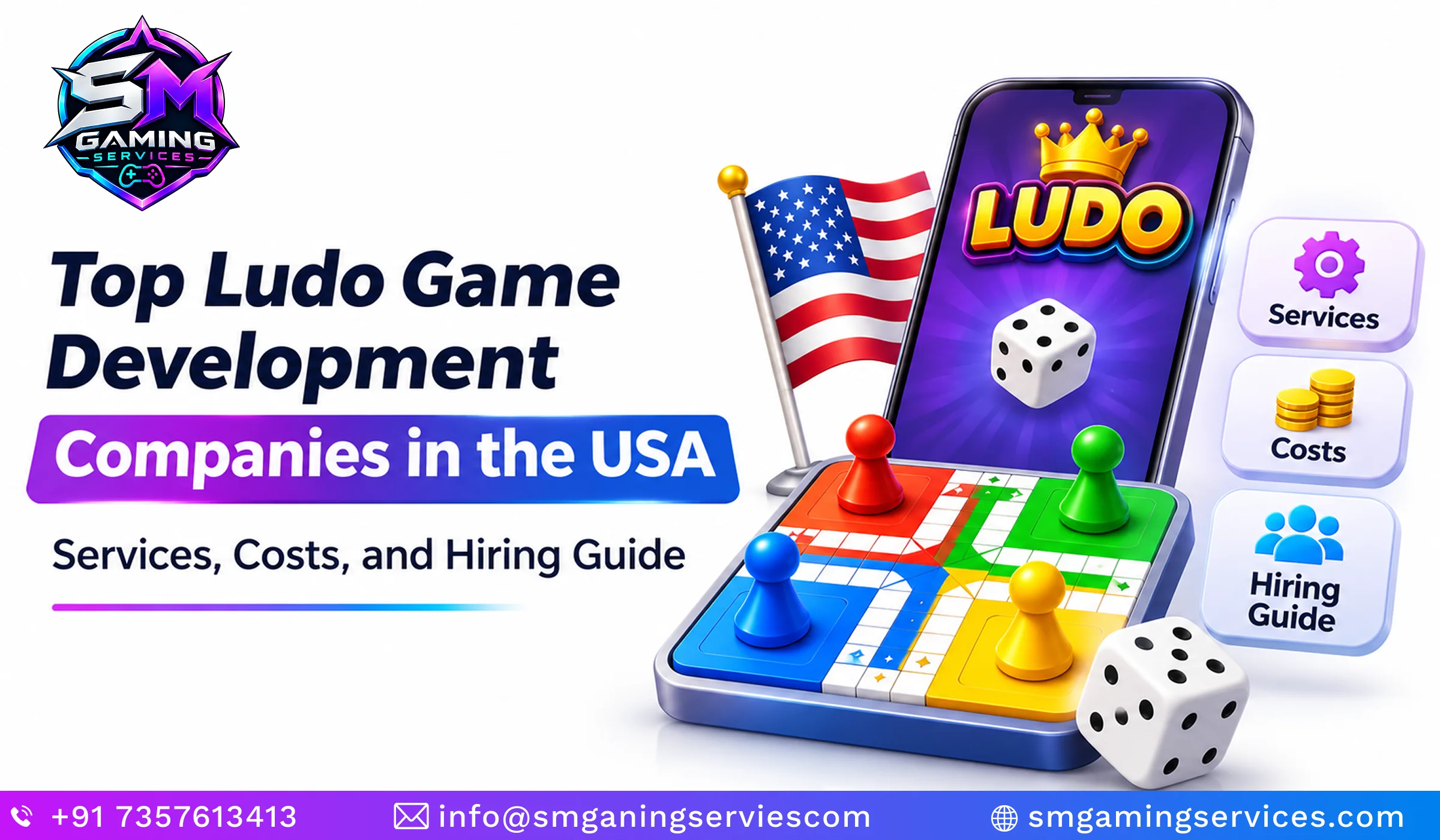
Choosing a Ludo development partner sounds simple until you start comparing proposals. One team promises a quick launch, another recommends a custom multiplayer backend, and a third offers a ready-made app with your branding. For a business owner, the real question is straightforward: which team can deliver games that people enjoy playing and that your business can operate?
This guide to Ludo game development companies in USA helps you assess that decision through practical criteria: relevant experience, multiplayer reliability, development scope, ownership, and ongoing support. It covers providers with a US presence alongside international options, with those differences clearly identified.
Published by SM Gaming Services, this article includes our company in the shortlist. It is an editorial buying guide rather than an independent ranking or a claim that every provider is headquartered in America. You will find questions to ask, an illustrative budgeting framework, and features worth prioritizing before you hire Ludo game developers. The goal is to help you choose a partner based on evidence and a workable plan.
Quick answer: Juego Studios and SDLC Corp publicly advertise Ludo game development services. Cubix offers relevant mobile and board-game development experience, although a Ludo-specific project should be requested. SM Gaming Services is an international option for discussing a custom build. Compare live demonstrations, contractual ownership, multiplayer testing, and support before choosing.
Key takeaways
- Verify Ludo experience through a playable build or documented project.
- Distinguish a US office from the location of the delivery team.
- Compare identical features when reviewing development proposals.
- Prioritize reliable matches before adding advanced engagement features.
- Request separate estimates for development and ongoing operations.
- Agree on code ownership and account access before work begins.
- Test disconnections, interrupted matches, and cross-device behavior.
- Treat launch as the beginning of product improvement.
How Were These Ludo Development Companies Selected?
A shortlist should explain why each company appears and what still needs checking. We reviewed official company pages for Ludo services, mobile game capabilities, relevant portfolio information, and connections to the US market. A dedicated service page establishes an advertised offering; it does not independently prove delivery quality. Similarly, broader board game experience deserves consideration without being presented as confirmed Ludo expertise. The companies below represent different starting points for a buyer conversation. Their order reflects this publisher’s presentation, and buyers should validate project fit through demonstrations, references, and proposals.
Selection criteria
- Publicly described Ludo or related game development services.
- Relevant mobile, multiplayer, or board-game capabilities.
- Transparent distinction between US presence and international delivery.
- Evidence that buyers can investigate before signing.
Which Ludo Game Development Companies Should US Buyers Consider?
US buyers can begin with SM Gaming Services, Juego Studios, SDLC Corp, and Cubix, while recognizing that their documented experience differs. Juego Studios and SDLC Corp advertise Ludo development directly. Cubix provides adjacent board game and mobile development evidence. SM Gaming Services describes Unity, multiplayer, and mobile development capabilities and is included as the publisher’s own service option. This selection combines firms with US connections and an international alternative. Ask every provider to identify its contracting entity, delivery location, relevant project examples, and availability before treating it as a match.
SM Gaming Services
SM Gaming Services advertises Unity, multiplayer, cross-platform, and Android and iOS development, alongside testing and support. For a Ludo project, ask us to translate those capabilities into a specific scope covering rules, rooms, reconnection, administration, and launch. Our inclusion is promotional; buyers should request relevant demonstrations and confirm delivery arrangements rather than assume US headquarters or independently verified Ludo results.
Discuss with our team
- Your audience, platforms, and preferred game rules.
- A prototype with measurable acceptance criteria.
- Multiplayer architecture and testing requirements.
- Ownership, maintenance, and milestone pricing.
Source: SM Gaming Services official website.[1]
Juego Studios
Juego Studios publishes a dedicated Ludo development page describing design, engineering, quality assurance, launch, and ongoing operations. Its company information identifies a local US entity, Juego Studios Inc, within a global delivery organization. Buyers considering a broader production relationship can ask for Ludo demonstrations, named delivery responsibilities, and a proposal explaining which specialists will work on their project after contracting.
Questions to ask
- Which Ludo examples can you demonstrate?
- Which entity signs the development agreement?
- Where will the assigned development team work?
- What does ongoing operational support include?
Sources: Juego Studios Ludo service page and company information.[2][3]
SDLC Corp
SDLC Corp advertises Ludo game development and describes a multiplayer Ludo project on its game development website. The published example mentions public and private rooms, timed turns, reconnection, and server validation. Its website also lists a US address. Ask for a playable demonstration, clarification of the team’s contribution, and testing evidence relevant to your expected launch audience and device mix.
Questions to ask
- Can the advertised multiplayer features be demonstrated?
- What backend components are included?
- How are interrupted matches recovered?
- Which hosting and maintenance costs remain separate?
Sources: SDLC Corp game development, Ludo services, and US address information.[4][5][6]
Cubix
Cubix publishes mobile game development services and a portfolio example involving a dominoes application across mobile and web. That makes it relevant to a board game shortlist, but it does not establish a completed Ludo project. Buyers should request Ludo-specific evidence, discuss turn-based multiplayer requirements, and confirm whether the proposed team has delivered comparable rules and match recovery systems previously.
Questions to ask
- Can you demonstrate a comparable turn-based game?
- What Ludo-specific work would be custom?
- Who owns the backend and deployment process?
- How will the team validate multiplayer reliability?
Source: Cubix Games official portfolio and services.[7]
How Do These Companies Compare at a Glance?
Comparison works best when every company answers the same questions. A service list can help you identify potential partners, but a proposal must explain the actual work your budget purchases. Use the table below as an initial screening tool, then request missing information directly. No standardized company pricing is supplied here because project requirements and commercial arrangements differ. When reviewing a Ludo game development company USA search result, check whether its US connection refers to headquarters, an office, a legal entity, or simply an international service offering before comparing proposals.
| Company | US connection or location distinction | Publicly documented relevance | What to verify |
| SM Gaming Services | International option; US headquarters not established by reviewed pages | Unity, multiplayer, mobile, and cross-platform services | Ludo demonstration, contracting entity, delivery arrangements |
| Juego Studios | Global organization identifying a local US entity | Dedicated Ludo development service | Assigned team, relevant shipped work, contract scope |
| SDLC Corp | Website lists a US address | Ludo services and a described multiplayer Ludo project | Playable build, team contribution, operational costs |
| Cubix | US-connected studio; reviewed material references Florida headquarters | Mobile games and a dominoes portfolio example | Ludo-specific experience and proposed implementation |
What Services Should a Ludo Development Proposal Include?
Ludo game development services should cover the complete journey from agreed rules to a maintained product. That usually means discovery, interface design, gameplay programming, multiplayer development, testing, deployment, and operational handover. The proposal should state what each stage produces and how you will accept it. Broader also includes accounts, notifications, analytics, accessibility, and support workflows around the game itself. Ask the team to separate essential launch work from later improvements so you can understand dependencies, control spending, and evaluate progress against working software throughout the delivery process.
Expected deliverables
- A rules document covering captures, safe squares, turns, and victory conditions.
- Interface designs and an interactive gameplay prototype.
- Player accounts, rooms, matchmaking, and backend administration.
- Device testing, deployment documentation, and operational handover.
- A written maintenance scope and defect resolution process.
What Features Should a Multiplayer Ludo Game Include?
A multiplayer Ludo game should make it easy to join, understand the rules, complete a fair match, and play again. Start with reliable rooms, clear turn indicators, consistent rule enforcement, and recovery after connection problems. Add engagement features when they support a defined player need. Reviewing can generate ideas, but each addition should earn its place in the roadmap. Before approving advanced features, ask whether your first audience would notice their absence and whether the development team can measure their effect after launch using player feedback.
Essential Gameplay and Social Features
Your first release should explain valid moves, show whose turn comes next, and help friends enter the same room without confusion. Include readable boards, responsive controls, sound settings, and clear match results. When researching Multiplayer Games Like Ludo, study how players discover opponents and organize repeat sessions, then adapt useful patterns to your own audience instead of copying competitors blindly.
- Guest access or simple account creation.
- Public matchmaking and private room invitations.
- Clear timers, move feedback, and results.
- Optional offline play if included in scope.
Reliable Multiplayer and Fair Play
The server should validate important match actions so players cannot simply alter local data to change outcomes. Ask developers to demonstrate duplicate request handling, reconnection, turn expiry, and consistent results across devices. A game that survives a brief network interruption creates more confidence than an impressive feature list that fails during routine matches with friends using ordinary mobile internet connections.
- Server validation of dice results and legal moves.
- Recovery of the latest confirmed match state.
- Defined behavior when a player leaves.
- Logs that help investigate disputed outcomes.
Tournaments and Ongoing Engagement
needs more than a tournament button. Define entry rules, scheduling, player matching, scoring, tie resolution, cancellations, and dispute handling before estimating the work. For early releases, consider simple competitions without cash stakes. Add leaderboards, events, and cosmetic rewards only when your team can operate them consistently and explain the rules clearly to every participating player beforehand.
- Published competition rules and eligibility.
- Consistent scoring and tie resolution.
- Administration tools and support workflows.
- Event analytics and documented cancellation behavior.
How Much Does Ludo Game Development Cost in USA?
in USA depends on the work required and the delivery team’s commercial model. A basic offline app, an online multiplayer MVP, and a tournament platform involve different engineering commitments. Rather than presenting unsupported market averages, the table below uses illustrative effort and hourly rates to show how budgeting works. These figures are arithmetic examples, not vendor quotations or surveyed US prices. Request a scoped estimate that separates design, programming, testing, deployment, and recurring operations, then compare providers using the same assumptions and exclusions before approving budgets.
| Illustrative scope | Assumed effort | Assumed blended rate | Calculated development budget |
| Basic offline app | 400–700 hours | 75–125/hour | 30,000–87,500 |
| Online multiplayer MVP | 900–1,500 hours | 75–125/hour | 67,500–187,500 |
| Expanded commercial product | 1,600–2,600 hours | 75–125/hour | 120,000–325,000 |
How Do You Hire Experienced Ludo Game Developers?
To hire Ludo game developers, begin with a written brief and ask shortlisted teams to respond to the same requirements. Explain your audience, preferred platforms, game modes, budget boundaries, and launch priorities. Request practical evidence before relying on promises about speed or scalability. A useful development partner should identify uncertainties and propose a way to resolve them. If you plan to evaluate the operational relationship as carefully as the initial build because support, reporting, and ongoing changes will influence your workload after public launch.
Define a Focused First Release
Describe one primary audience and the smallest experience that gives those players a reason to return. Specify platforms, rules, room types, and essential account features. Separate requirements from optional ideas. A focused brief lets each custom Ludo game development company estimate comparable work and gives you a practical basis for deciding what belongs in the first release and later updates.
- Define target players and initial launch region.
- Document rules and supported platforms.
- Prioritize essential features.
- Identify measurable acceptance criteria.
Test Evidence Through a Demonstration
Ask the team to run a complete match on separate devices, interrupt one connection, and demonstrate recovery. Discuss which components it built and which belong to third parties. If client confidentiality prevents sharing an existing project, request an agreed prototype or technical walkthrough. Evidence should answer your actual delivery questions rather than simply showcase attractive screens and polished sales presentations.
- Observe room creation and invitations.
- Test a connection interruption.
- Review the team’s project contribution.
- Ask for references where available.
Agree on Delivery and Ownership
Before development starts, document milestones, payment triggers, review periods, and change requests. Confirm ownership of custom code and artwork, along with any third-party restrictions. Establish who controls hosting, source repositories, store accounts, and analytics. Clear arrangements make handover easier and reduce dependence on informal promises when your game needs maintenance, a new feature, or another development partner in the future.
- Specify deliverables and acceptance procedures.
- Record code and asset ownership terms.
- Define account access and handover.
- Agree on support responsibilities.
How Long Does Ludo Development Take, and What Can Go Wrong?
Development time depends on scope, team capacity, reused components, and the number of approval cycles. A credible schedule should explain its assumptions and identify dependencies such as artwork approval, backend decisions, and store submission. Ask for a milestone plan rather than accepting a single promised launch date. Multiplayer Ludo game development particularly benefits from testing interrupted sessions and unusual rule combinations before public release. Plan a controlled launch with a limited audience so the team can observe real behavior, address defects, and revise priorities before increasing promotion and acquisition spending.
| Milestone | Reviewable output | Question for the buyer |
| Discovery | Rules, feature list, architecture outline | Are assumptions and exclusions explicit? |
| Prototype | Playable core match | Is the game understandable and enjoyable? |
| Multiplayer implementation | Shared matches and recovery | Do devices stay consistent after interruptions? |
| Testing | Defect reports and test results | Have priority issues been resolved? |
| Controlled launch | Live feedback and monitoring | Is the product ready for a wider audience |
How Can You Choose a Ludo Development Partner With Confidence?
Choose the team that connects your business goals to demonstrable work, a clear proposal, and realistic operating responsibilities. Relevant experience matters, but so does the willingness to explain tradeoffs and answer difficult questions. At SM Gaming Services, our published services include mobile games, Unity development, multiplayer functionality, testing, and support. Bring us your audience, preferred platforms, and launch priorities so we can discuss a project-specific approach. Compare that proposal against your shortlist, check the evidence, and choose the relationship that gives you clarity about delivery, ownership, and the next steps.
Contact us today to discuss your Ludo game concept and request a tailored development proposal.
Frequently Asked Questions
Q1. Which Companies Offer Ludo Game Development Services for US Buyers?
Juego Studios and SDLC Corp advertise dedicated Ludo development services. SM Gaming Services offers relevant multiplayer, Unity, and mobile development capabilities for a project discussion. Cubix provides adjacent board game experience, although Ludo-specific evidence should be requested. Verify the contracting entity, delivery location, available team, and relevant demonstrations before selecting a provider for your own requirements and intended launch market.
Q2. How Much Does It Cost to Build a Custom Ludo App?
Custom Ludo app development cost depends on platforms, design, multiplayer infrastructure, testing, and operational tools. This guide provides illustrative effort-based calculations rather than market averages or company quotes. Ask shortlisted vendors for itemized estimates using identical requirements. Compare exclusions, recurring charges, revision allowances, and maintenance terms before deciding which proposal offers a workable budget for your planned release and operations.
Q3. How Long Does It Take to Develop a Ludo Game?
There is no reliable universal timeline without a defined scope. An offline prototype needs different work from an Android and iOS multiplayer product with administration and tournaments. Ask for milestone dates, staffing assumptions, dependencies, and review windows. Include time for testing, revisions, and submission preparation, and agree how scope changes will affect the schedule before approving the development plan together.
Q4. Which Technologies Can Be Used for Online Ludo Development?
Unity is one option for building the game client; Ludo King provides a published example of its use. The backend, database, hosting, and communication layer require separate decisions. Ask the team to explain its proposed architecture through practical outcomes: consistent turns, reconnection, monitoring, maintainability, and expected operating costs. Choose technology around your requirements rather than a long list of tools.
Q5. Can a Ludo Game Support Both Android and iOS?
Yes, Android and iOS Ludo game development can share substantial gameplay code through a suitable cross-platform approach. However, each platform still requires testing and release work. Define supported devices, account behavior, notifications, purchases, and cross-platform matchmaking explicitly. Ask the provider to demonstrate players completing the same match across both operating systems before accepting that part of the project as complete.
Q6. Should I Choose Custom Development or a Ready-Made Ludo App?
Choose according to your required control, differentiation, budget, and operational capacity. A ready-made solution may reduce initial implementation work, while custom development offers flexibility where the agreement assigns the necessary rights. Compare actual demonstrations and contract terms. Check modification access, hosting options, recurring fees, data export, and whether another team can maintain the product if your original vendor becomes unavailable.
Q7. What Should Buyers Consider Before Adding Real Money Features?
Treat real money ludo game apps as a separate product decision requiring specialist review before development commitments. Ask qualified advisers to assess the intended markets and proposed mechanics, and confirm applicable platform and payment requirements. Then request a distinct technical scope. Do not assume a vendor’s existing wallet feature establishes launch permission or that cash features suit every business model.
Q8. What Should a Ludo Development Proposal Include?
A useful proposal includes the rules, platforms, features, architecture, team responsibilities, milestones, acceptance criteria, and itemized commercial terms. It should explain testing, hosting, third-party dependencies, intellectual property, and handover. Ask for explicit exclusions and maintenance arrangements. You should understand what you receive, what you must provide, and how both parties handle defects and changes before committing to the project formally.