

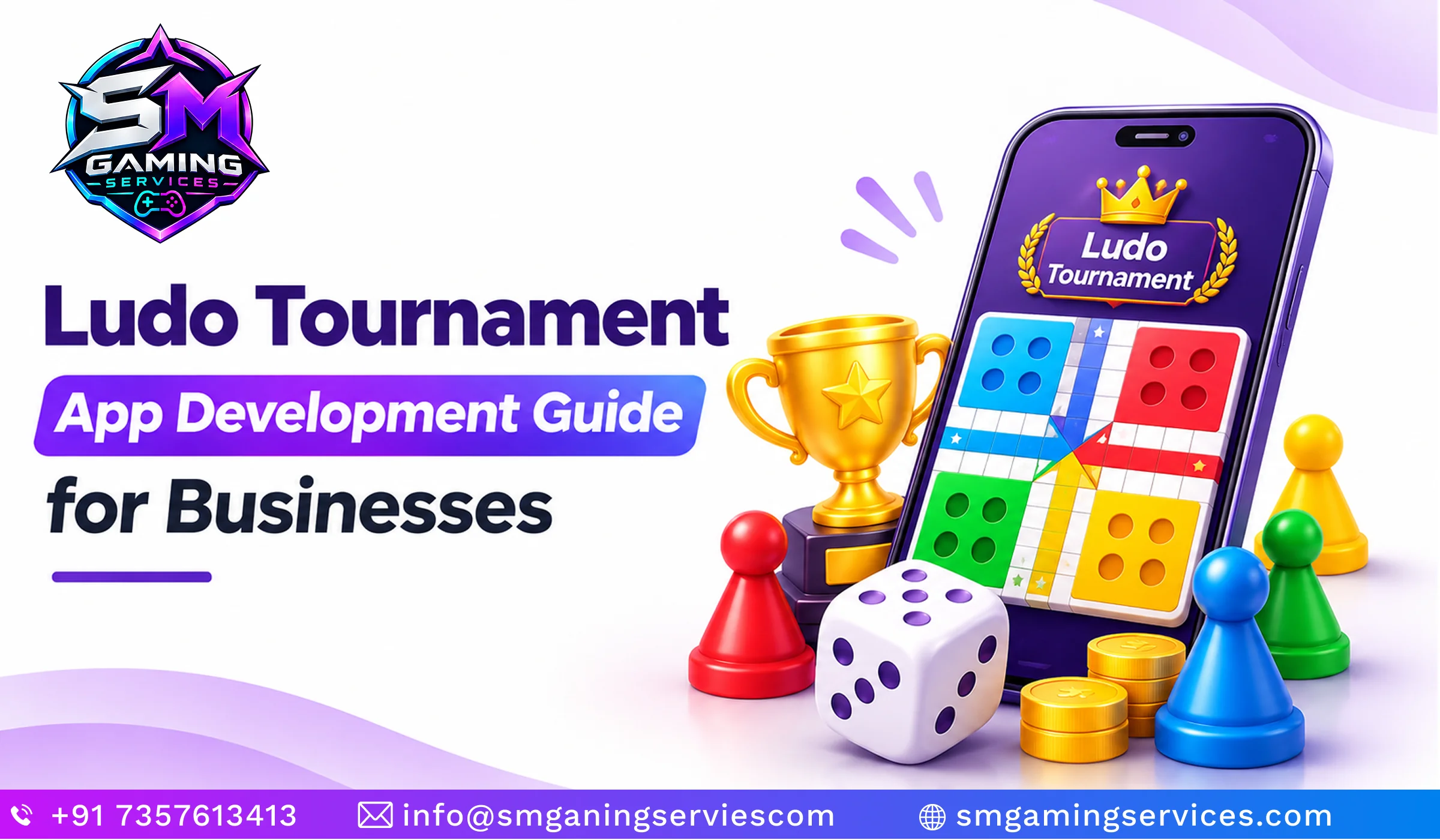
Sixteen players register for a Friday night Ludo tournament. At the starting time, fourteen check in. One player loses their connection during the opening round, and two others finish early and want to know when they can play again. The board may work perfectly in all three situations. The tournament still needs to decide who gets a seat, when a match ends, and what every player sees next. Those decisions shape the experience as much as the dice and tokens do.
Ludo tournament app development brings multiplayer gameplay, event scheduling, and competition rules into one playable product. This guide is for founders, gaming businesses, and community operators planning an Android or iOS launch. It starts with a free, head-to-head knockout tournament and shows what changes when you add more formats or platforms. You’ll see what to include in a minimum viable product (MVP), how to estimate the build, and what an organizer needs to run an event from registration through the final result without manually moving players through each round.
Quick Answer
A Ludo tournament app runs scheduled online competitions with defined rules for joining, scoring, and advancement. Players register, check in, enter a match lobby, and advance by winning matches or earning enough points. A launch MVP needs registration, match assignment, server-controlled gameplay, timers, reconnection, automatic results, a bracket, and basic organizer tools.
What Is a Ludo Tournament App and How Does It Work?
A Ludo tournament app organizes matches into a competition with a published schedule, entry rules, and a way to decide who advances. Players join through an event page, then follow their assignments until they are eliminated or the tournament ends. A multiplayer room can close once it declares a winner. A tournament must carry that result forward, assign the next opponent, and tell both players when to return. The event page should show whether a player is registered, checked in, waiting for a match, or through to the next round.
How Players Join and Complete a Ludo Tournament
Players sign in, choose an event, and check the start time and rules before registering. At check-in, the app confirms their seat and sends them to a lobby. Once assigned an opponent, they play within the turn and match limits. Afterward, they can see the result, their bracket position or leaderboard rank, and any upcoming match they need to join.
| Stage | Players | Matches | What one player sees |
|---|---|---|---|
| Registration and check-in | 16 | 0 | Meera registers, checks in, and receives a first-round assignment. |
| Round of 16 | 16 | 8 | Meera wins her first match and advances. |
| Quarterfinals | 8 | 4 | She wins again and gets a semifinal assignment. |
| Semifinals | 4 | 2 | She wins her third match and qualifies for the final. |
| Final | 2 | 1 | She wins the fourth match and appears as champion. |
Ludo Tournament App vs. Regular Multiplayer Ludo App
When reviewing Multiplayer Games Like Ludo, look at how each game handles the minutes between matches. Instant rooms serve players who want a quick game. Private rooms suit groups that already know whom they want to play. Tournament lobbies serve players who need an official opponent, a round deadline, and a result that counts toward a shared bracket or ranking.
| Format | Scheduling | Scoring and ranking | Best for |
|---|---|---|---|
| Casual multiplayer | Start when seats fill | Single-match result | Quick games |
| Private multiplayer room | Group chooses when to play | Single-match result or group tally | Friends and private groups |
| Tournament | Published check-in and round windows | Bracket advancement or event leaderboard | Competitive events |
Which Tournament Formats Can a Ludo App Support?
A Ludo app can support knockout brackets, round-robin leagues, and points-based events. Knockouts fit short competitions, while leagues and points events give players more opportunities to play and recover from a loss. The format determines how many matches the organizer must schedule and what happens when players leave early. For example, an eight-player head-to-head round robin takes 28 matches if everyone plays everyone once. An eight-player knockout takes seven. Choose the format based on how often your audience can show up and how much time organizers can give each event.
Knockout, League, and Points-Based Tournaments
In a knockout, one loss eliminates a player, and each winner moves to the next round. In a round robin, everyone plays each opponent in their group, and standings determine the winner. A points-based event ranks players by results earned during a window. Set a match cap or a fixed number of scoring games to keep participation volume from dominating.
| Tournament format | How players progress | Scheduling needs | Best use |
|---|---|---|---|
| Single-elimination knockout | Winners advance until one remains | Short, dependent rounds | One-evening events |
| Round-robin league | Group standings determine the winner or qualifiers | Multiple fixtures per player | Recurring competitions and small groups |
| Points-based leaderboard | Eligible results accumulate under published scoring rules | Fixed scoring window and match limits | Larger player pools and flexible play |
Public Tournaments and Private Competitions
Public events use an open registration page and a published start time. Private competitions restrict entry through invitations or room codes, and community hosts may manage their schedules. Close registration before seeding so the app can confirm the player count. If a tournament fills, use a waitlist and give replacements a deadline to accept an open seat before check-in closes.
What Features Should a Ludo Tournament App Include?
The core online Ludo tournament app features are event registration, match assignment, reliable gameplay, reconnection, official results, and a way to manage exceptions. Give organizers enough control to run an event without developer help. Give players enough information to know when and where to play. Think about the feature list from both sides. A reminder is useful only if it leads to the right match. A bracket is useful only if it updates after results are confirmed. Those connections matter more at launch than a large catalogue of event formats.
Player Features
Players should see their next action from the tournament page. Before registration, show the start time, rules, and expected commitment. After check-in, show the lobby, opponent assignment, and countdown. During a match, keep the turn timer visible and restore the board after reconnecting. Once play ends, show the official result, recent match history, and what the player should do next.
- Event discovery, registration, check-in, and reminders
- Live gameplay, visible turn timers, and reconnect support
- Match history, brackets, leaderboards, and round status
Admin Features
An organizer needs to create a tournament, set its capacity and schedule, and publish the rules players will see. During the event, the admin dashboard should show who checked in, which matches are overdue, and which results need review. Afterward, compare registrations, completed matches, and drop-offs by round to find where players had trouble or left before finishing their game.
- Scheduling, rule presets, and participant management
- Match logs, dispute review, and recorded admin decisions
- Registration, check-in, match completion, and drop-off reports
How Do You Develop a Ludo Tournament App?
Build one tournament from registration to the final result before adding formats. Write the rules first, then implement the board, match service, event workflow, and admin controls around those rules. In multiplayer Ludo game development, the difficult handoffs happen when a match starts, a phone disconnects, or a winner needs to be placed into the next round. Test those moments before investing in boards or seasonal content. If you’re planning to Start an Online Ludo Game Business, use the first closed tournament to measure how many registered players actually finish.
Define the Rules and Build the MVP
Pick a launch platform, a match size, and one format. Write down what happens when a registered player misses check-in, runs out of time, or disconnects. Decide how to break ties in timed matches and when to cancel an event with too few players. Turn those decisions into acceptance criteria so designers, engineers, and tournament operators use the same rules.
Build Multiplayer Gameplay and Test Before Launch
The server should generate dice rolls, validate moves, and own the official match state. A reconnecting phone fetches the current board and timer from that server. Test two phones submitting actions at the same time and a result being delivered twice. Run a closed beta with real players, then inspect every manual intervention before opening public registration for the event.
- Test late arrivals, missed turns, abandoned matches, and server interruptions.
- Run overlapping events and check that each player receives the correct match assignment.
- Retry result delivery and confirm the winner advances only once.
How Much Does Ludo Tournament App Development Cost?
In an illustrative India-based model, an Android MVP costs ₹9.6–18 lakh to build. An Android and iOS release costs ₹24–48 lakh at that rate. These figures come from multiplying assumed person-weeks by a rate of ₹60,000 per person-week. They are planning scenarios with no vendor quotes. The MVP assumes a free, head-to-head knockout with 100 concurrent players at peak. The advanced scenario assumes 1,000 concurrent players, multiple event formats, and more admin tools. A Ludo game development cost estimate should show which scope and testing assumptions drive the quote.
MVP vs. Advanced App Cost Breakdown
Ask your mobile app development partner to itemize design, gameplay, tournament logic, backend engineering, and testing. The table uses Indian rupees and separates both scopes. Build budgets cover one-time delivery work. Hosting, monitoring, updates, and player support are recurring operating expenses. Estimate those separately using scheduled event frequency, peak concurrent players, expected match duration, and your planned player support coverage.
| Cost driver | Android tournament MVP | Advanced tournament app |
|---|---|---|
| Platforms | Android | Android and iOS |
| Gameplay | Two-player matches with timers and reconnection | Two- and four-player modes with broader device testing |
| Tournament formats | Free single-elimination bracket | Knockouts, leagues, and points events |
| Admin tools | Scheduling, match logs, and basic disputes | Host permissions, review queues, and event analytics |
| Peak design target | 100 concurrent players | 1,000 concurrent players |
| Estimated effort | 16–30 person-weeks | 40–80 person-weeks |
| Illustrative build cost | ₹9.6–18 lakh | ₹24–48 lakh |
| Recurring expenses | Hosting, monitoring, maintenance, and support priced separately | Same categories, sized for higher traffic and more events |
What Affects the Development Timeline?
Custom board art, platform releases, more tournament formats, and higher concurrency targets can extend delivery. An illustrative Android schedule is two weeks for rules and design, four to six for gameplay and tournament development, two to three for multiplayer testing, and one for a closed beta. That gives a nine-to-twelve-week planning window if approvals and fixes fit inside those phases.
How Can a Ludo Tournament App Make Money?
A free-entry Ludo tournament app can generate revenue from rewarded ads, subscriptions, cosmetics, and sponsored events. Choose placements that keep the board and turn clock clear during competition. If your audience gathers for a weekly event, sponsorship may be easier to test than a subscription that needs to deliver value throughout the month. If players return for several sessions a week, cosmetics or optional profile perks give them a purchase option outside the match. Track revenue alongside check-in and match completion to see whether a placement is costing you participation.
Ads, Subscriptions, and Sponsored Events
Rewarded ads can offer optional cosmetic rewards from the lobby or post-match results screen. Subscriptions can unlock profile customization or an ad-free casual experience. Cosmetic purchases can change boards, tokens, or avatars while preserving competition rules. Sponsors can appear on event pages and standings. Give each model its own placement and track whether players return after seeing or using it.
| Revenue model | Suitable placement | Example |
|---|---|---|
| Rewarded ads | Results screen or casual lobby | Optional ad for a cosmetic reward |
| Premium subscription | Profile or store | Extra profile themes |
| In-app cosmetics | Store or customization screen | Token skins and board themes |
| Sponsored events | Event page and results | Branded community championship |
What Should Businesses Consider Before Offering Paid Entry or Cash Prizes?
Treat real money Ludo game apps as a separate product decision. For each target market, get a legal review of the entry and prize rules, then check store eligibility. Apple’s guideline 5.3 addresses contests and real-money gaming. Google Play generally prohibits staking money for prizes of real-world value outside eligible exceptions. Verify policies before budgeting for payments or announcing tournaments.
How Do You Keep Online Ludo Tournaments Fair?
Keep the server in charge of dice, legal moves, timers, and results. Publish the rules before check-in and retain enough match history to explain a disputed outcome. When reviewing Ludo game development trends, evaluate fairness against situations your support team will actually see. A player may report a suspicious run of dice rolls, claim the timer expired too soon, or say their opponent left deliberately. Each report calls for different evidence. The event record should let an administrator reconstruct what happened and apply the same published rule to similar cases.
Fair Dice Rolls and Cheating Prevention
Generate each roll on the server with a random integer function designed to avoid modulo bias. Node.js documents it for its crypto.randomInt function. Validate every move against the board, turn, and roll, then log accepted actions in order. Flag patterns such as repeated pairings with coordinated forfeits or suspected duplicate accounts. Review flagged activity alongside match history before applying penalties.
Disconnects, Disputes, and Match Results
Publish a reconnect window and tell players whether the turn clock continues while they are offline. If a player returns before the cutoff, restore the saved board and remaining time. Apply the published missed-turn or forfeit rule when the window expires. Reserve replays for defined cases such as a confirmed server failure, and record the evidence behind each changed result.
Conclusion
A first Ludo tournament needs a published rulebook, a registration and check-in flow, reliable multiplayer matches, automatic advancement, and an organizer who can handle exceptions. Start with a format your audience can finish in one sitting. Use the beta to learn where players miss check-in, how often connections drop, and which results require support. Those observations give you a basis for choosing the next format or deciding when to add another platform. The initial scope also gives your team a clear basis for estimating design, testing, and launch support.
Planning your first event? Contact SM Gaming Services to discuss your tournament format, MVP scope, and estimate for Ludo Tournament App Development.
Frequently Asked Questions
Q1. How long does it take to build a Ludo tournament app?
Ans. A free Android knockout MVP can take nine to twelve weeks under the illustrative schedule in this guide. That estimate assumes one board design, one match size, and timely feedback during design and beta testing. A new multiplayer engine, an iOS release, or a higher target for simultaneous players can extend delivery. Ask for milestones tied to playable matches and a complete test tournament.
Q2. Can I launch a Ludo tournament app for Android first?
Ans. Yes. Players can use the Android app while organizers manage events through a web dashboard. Keep registration, matchmaking, and tournament results on the backend so a future iOS app can use the same competition rules. During beta, test on lower-end Android devices and unstable connections to see how often players finish matches under conditions they’re likely to encounter.
Q3. What is the best tournament format for a Ludo app MVP?
Ans. A head-to-head single-elimination knockout is a practical choice for a scheduled launch event. Each match produces one advancing player, and the bracket makes it easy to see who plays next. Start with eight or sixteen seats and publish what happens when players miss check-in or seats go unfilled. A small round robin suits communities that prefer guaranteed repeat matches.
Q4. How does a Ludo app handle a player who disconnects mid-match?
Ans. The server keeps the official board state and timer. If the player returns within the published reconnect window, the app loads the current match state and resumes play under the event rules. If the player misses the cutoff, the app applies the stated penalty. When a player disputes a forfeit, support can review the disconnect and reconnect timestamps.
Q5. Can I add tournament features to an existing multiplayer Ludo game?
Ans. Yes, if the existing game can assign players to match sessions, verify the winner, and restore the board after a disconnect. You can build registration, brackets, and round progression around that match system. Test how the game handles interrupted matches and repeated result updates before launch. A confirmed result should advance the correct player exactly once.
Q6. How much does Ludo tournament app development cost?
Ans. The guide’s illustrative India-based model puts a free Android knockout MVP at ₹9.6–18 lakh. That assumes 16–30 person-weeks at ₹60,000 per person-week, with a design target of 100 concurrent players. Treat this as a planning estimate and budget separately for hosting, monitoring, maintenance, and player support. A second platform or additional tournament formats can increase the build cost.
Q7. Can a Ludo tournament app support private competitions?
Ans. Yes. Organizers can invite players directly or share an event code with a community. For a private knockout, set the seat limit, registration deadline, and check-in window before sharing the invitation. Once check-in closes, seed the bracket using confirmed players. Publish how the organizer will fill empty seats or award byes so participants know what to expect.
Q8. How can a free Ludo tournament app make money?
Ans. A free-entry app can earn revenue through optional rewarded ads, cosmetic purchases, premium subscriptions, or sponsored events. Put ads on the results screen or in the lobby so they don’t interrupt turns. Sell visual extras such as token skins or board themes while keeping competition rules the same for everyone. Sponsors can appear on event pages and standings.

3 Comments
[…] events scoped separately. If you later add brackets, scheduling, and event administration, your Ludo tournament app development guide can explain those product requirements in […]
[…] ordinary matches. Specify how ties, late arrivals, disconnects, and cancellations are handled. Ludo Tournament App Development should begin with an explicit competition format and support workflow. Introduce non-cash events […]
[…] and optional events can support that purpose without overwhelming the board. For teams offering Ludo Tournament App Development, organized competition adds requirements around scheduling, eligibility, scoring, and dispute […]