
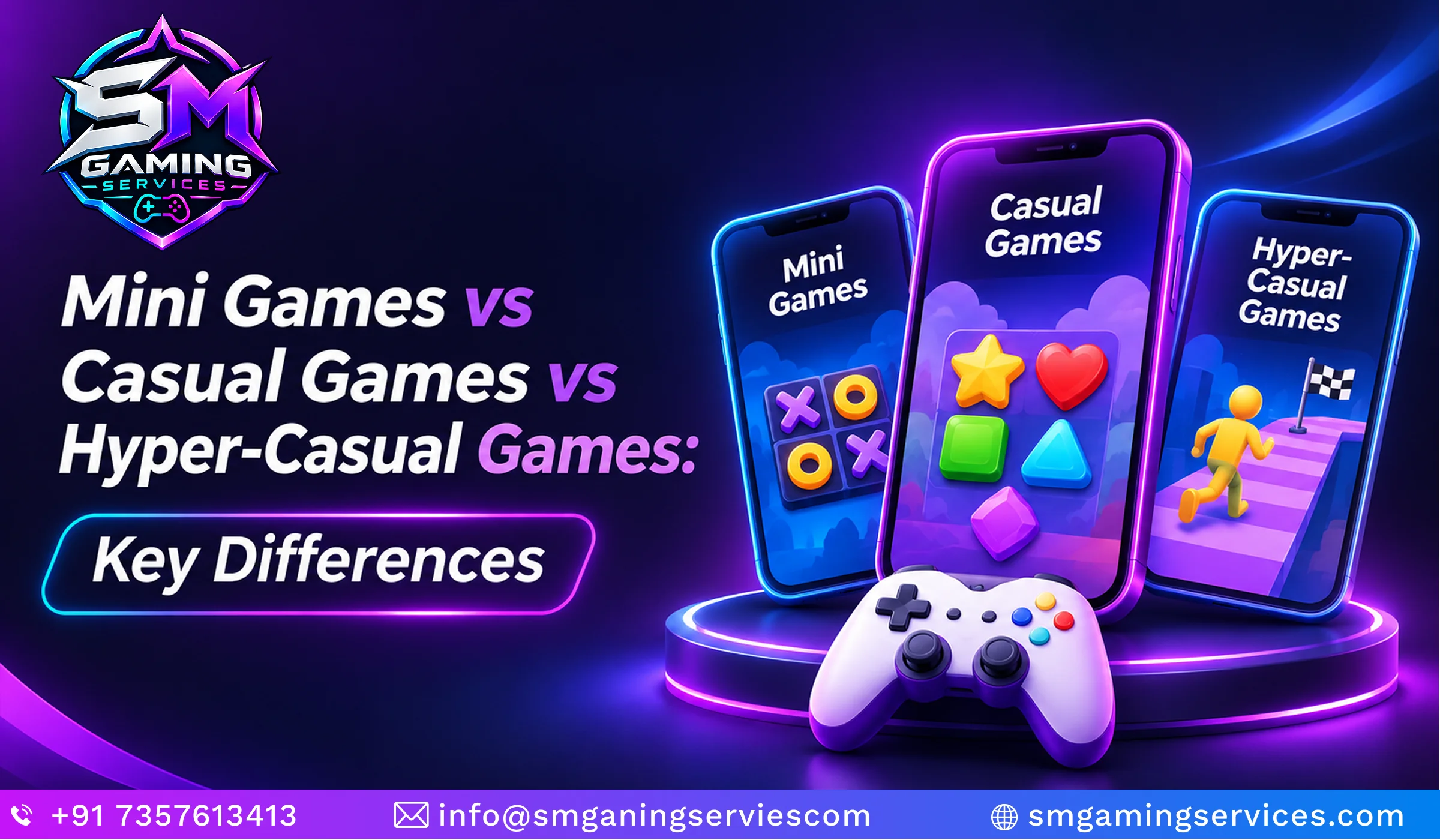
Choosing a game format starts with understanding what players will do, why they will return, and how the experience supports your goals. The comparison of mini games vs casual games vs hyper-casual games helps explain these decisions, but the categories overlap. A mini game can be casual, and a compact challenge can use hyper-casual mechanics.
Mini games usually describe limited gameplay scope or a small activity within another experience. Casual games emphasize accessible rules and approachable play, sometimes supported by substantial progression. Hyper-casual games center on extremely simple mechanics that players can understand almost immediately.
These differences influence controls, content requirements, player retention, development effort, and monetization. However, no category automatically guarantees lower costs, stronger engagement, or higher revenue.
This guide compares the three formats through practical examples, a detailed comparison table, and business considerations. Whether you are exploring a branded campaign, a browser experience, or a standalone mobile product, understanding the distinctions will help you choose a format that matches your audience, resources, and long-term plans before development work begins.
1. What Is the Difference Between These Game Categories?
Mini games describe compact scope, casual games describe accessible play, and hyper-casual games emphasize extremely simple core mechanics. These labels answer different questions, so they should not be treated as mutually exclusive categories. A short memory challenge inside a shopping app could qualify as both a mini game and a casual experience. Meanwhile, a standalone obstacle game could use hyper-casual mechanics without being part of another product. Understanding this distinction helps businesses compare projects accurately, set realistic requirements, and avoid choosing a development approach based only on a popular label.
What Are the Main Takeaways?
The most useful comparison considers the experience players receive rather than the label attached to it. A game with one action can still require extensive testing, while an accessible puzzle can support years of content. Businesses researching what are mini games should first separate gameplay scope from accessibility, progression, distribution, and commercial objectives before selecting their preferred format for development.
- Scope: Mini games usually focus on a compact activity.
- Accessibility: Casual games are approachable for their intended audience.
- Mechanics: Hyper-casual games minimize the effort needed to understand play.
- Progression: Depth varies and can change how a game is classified.
- Sessions: Short gameplay sessions appear across all three categories.
- Revenue: Monetization depends on audience behavior and product design.
Why Can These Categories Overlap?
Consider a simple stacking challenge embedded in a larger adventure. Its limited role makes it a mini game, its approachable controls make it casual, and its immediate interaction may resemble hyper-casual design. If that same challenge becomes a standalone app with collections and upgrades, its scope and positioning change. Classification therefore depends on context, not simply the mechanic being used.
2. What Defines Each Type of Game?
Definitions become more useful when connected to actual design decisions. Mini games typically concentrate on one activity or a limited set of objectives. Casual games reduce barriers to participation through understandable rules and approachable interactions. Hyper-casual games push that accessibility further through immediately readable objectives and minimal controls. None of these descriptions establishes a universal duration, file size, or production budget. When evaluating mini games vs casual games, examine how much content exists, how players learn, and what encourages them to return after completing their first successful round or challenge.
What Makes a Game a Mini Game?
A mini game is a compact gameplay experience with a focused objective, whether it operates independently or appears inside another product. Examples include a fishing activity within an adventure, a website quiz, or a memory challenge. For Mini Games development, define the activity, entry point, completion condition, and intended repeat behavior before deciding how much supporting functionality the experience needs.
Common characteristics include:
- A clearly defined activity or challenge.
- Limited gameplay scope.
- A standalone or embedded format.
- Focused entertainment, engagement, or learning goals.
What Distinguishes Casual and Hyper-Casual Design?
Casual design makes play approachable without necessarily limiting depth. A puzzle may introduce new obstacles, collections, and strategic choices over time. Hyper-casual design concentrates more heavily on an immediately understandable interaction, such as tapping to jump or dragging to steer. Unity similarly describes hyper-casual games through lightweight design and simple mechanics, although individual games vary in progression and presentation over time. Unity
The practical distinction is:
- Casual games can combine accessibility with substantial content.
- Hyper-casual games emphasize an immediate, easily repeated core interaction.
- Adding deeper systems can move a project toward hybrid-casual design.
3. How Do Gameplay, Progression, and Sessions Compare?
Gameplay comparisons should examine what happens before, during, and after a round. Controls determine how players interact, objectives explain success, and progression provides reasons to continue. Mini games may end after one completed activity, while casual products can connect rounds through levels or collections. Hyper-casual experiences often emphasize quick understanding and repeated attempts. However, short rounds do not automatically create short overall sessions. Players might repeat a brief challenge many times. The table below compares common tendencies while allowing for exceptions across different platforms, audiences, and individual game design choices.
| Comparison Point | Mini Games | Casual Games | Hyper-Casual Games |
|---|---|---|---|
| Main defining feature | Compact scope or supporting role | Accessible gameplay | Extremely simple core mechanics |
| Typical objective | Complete a focused activity | Solve, build, collect, or progress | Execute an immediately understandable action |
| Controls | Depend on the activity | Approachable, sometimes with multiple actions | Often tap, swipe, hold, or drag |
| Learning curve | Usually limited, but context matters | Accessible introduction with room for depth | Minimal initial explanation |
| Progression | Optional or connected to a larger experience | Can include levels, collections, and upgrades | Often lighter; deeper systems may suggest hybrid-casual |
| Session structure | One activity or several repeated rounds | Flexible play across connected activities | Brief, repeatable gameplay loops |
| Distribution | Browser, app, messaging platform, or larger game | Mobile, browser, desktop, or console | Commonly associated with mobile distribution |
| Content requirements | Defined by the activity and integrations | Can require substantial ongoing content | Can require extensive mechanic and variation testing |
| Revenue options | Sponsorship, licensing, ads, or purchases | Ads, purchases, premium access, or subscriptions | Frequently advertising, with other options possible |
| Classification caution | Small does not automatically mean simple | Accessible does not mean shallow | Simple mechanics do not guarantee commercial success |
How Do Controls and Learning Curves Differ?
Simple game mechanics reduce the effort required to begin, but good controls still need feedback, responsiveness, and accessibility testing. A quiz requires different input decisions from a runner or card game. When evaluating Mini Games to play for inspiration, observe whether objectives are clear, mistakes are understandable, and players can restart without confusion, frustration, or unnecessary steps between repeated attempts.
How Do Progression and Replayability Differ?
Replayability comes from meaningful variation, improving skill, competition, or satisfying objectives. Game progression adds another layer through unlocks, levels, or collections. A compact experience can be replayable without persistent upgrades, while a casual product may need substantial progression content. Evaluate mini game ideas by asking what changes between attempts and why someone would willingly return after the initial novelty fades.
4. Which Examples Best Explain the Differences?
Examples help readers understand categories, but classification should include context rather than rely on a game title alone. A memory activity can appear as a promotional mini game, an accessible standalone product, or part of a larger collection. Similarly, a simple runner may gain upgrade systems that change its overall design. When comparing casual games vs hyper-casual games, examine the complete experience, including menus, progression, and content. The examples below illustrate recognizable patterns without suggesting that every game using those mechanics belongs permanently to one fixed category across all versions.
What Are Useful Mini Game and Casual Game Examples?
A fishing activity inside an adventure illustrates the supporting role of a mini game. A standalone solitaire product illustrates accessible casual play with room for difficulty options and additional modes. The difference between mini games and casual games therefore concerns scope versus accessibility. Neither example establishes a universal rule about required installation, production quality, player age, or potential commercial value.
Mini game examples:
- A timed quiz inside a learning platform.
- A fishing challenge within a larger adventure.
- A branded memory-matching activity.
- A short browser-based score challenge.
Casual game examples:
- Solitaire.
- Match-three puzzles.
- Word games.
- Accessible farming or decorating games.
What Are Useful Hyper-Casual and Hybrid-Casual Examples?
Imagine a game where players hold the screen to grow a bridge and release to cross a gap. That immediate interaction illustrates hyper-casual design. Adding persistent upgrades, collections, and longer-term goals may create a hybrid-casual experience. Unity describes hybrid-casual design as simple core gameplay supported by additional engagement layers, making the surrounding systems important to classification alongside the main mechanic itself. Unity
Illustrative hyper-casual mechanics include:
- Tapping to avoid an obstacle.
- Dragging to guide an object.
- Timing a release to land accurately.
- Stacking items while maintaining balance.
5. How Do These Games Generate Revenue?
Revenue depends on the relationship between player motivation, distribution, and the value offered. Advertising may suit repeated free play, while purchases need compelling benefits that fit the experience. Branded projects can create commercial value through engagement or qualified actions instead of direct player spending. Licensing can also support games distributed through another business. Understanding how mini games make money therefore requires looking beyond advertisements alone. Choose a model that supports the product’s purpose, then measure whether it improves results without weakening usability, satisfaction, or the reasons players keep coming back.
Which Monetization Models Fit Mini Games?
A mini game can generate revenue through sponsorship, licensing, advertising, premium access, or optional purchases. A promotional experience may instead support product discovery or customer engagement. For branded mini game development, define the desired business outcome before adding revenue features. A campaign designed to explain a product needs different success measures from a standalone game built around repeat ad-supported play.
Possible models include:
- Sponsorship: A business funds the experience.
- Licensing: Another company pays to distribute or use the game.
- Advertising: Suitable placements support free play.
- Purchases: Players pay for relevant content or benefits.
- Campaign value: The game supports measurable marketing outcomes.
How Do Casual and Hyper-Casual Monetization Differ?
Casual games can combine purchases with advertising when progression creates relevant purchase opportunities. Hyper-casual games commonly use advertising around repeatable rounds, although implementation varies. Rewarded placements offer a voluntary benefit, while interstitials interrupt the experience at selected transitions. Unity documents both formats, but the appropriate mix depends on audience behavior, retention, and the value delivered through each individual placement and reward. Unity
Questions to ask before choosing a model:
- Does the placement interrupt an important action?
- Is the reward clear and worthwhile?
- Would a purchase improve the experience without creating frustration?
- Does revenue remain healthy when player retention is considered?
6. What Affects Development Costs and Technical Requirements?
A useful game development cost comparison starts with a shared specification. Category names alone cannot explain the cost of artwork, integrations, multiplayer features, testing, or ongoing content. A small promotional game with secure rewards and several language versions may require more work than a basic standalone prototype. Likewise, simple mechanics can demand extensive tuning before they feel satisfying. When requesting game development services, separate the playable prototype, launch requirements, and ongoing operations. This makes proposals easier to compare and reveals which features drive effort across the entire planned product lifecycle.
Which Features Increase Development Effort?
Custom artwork, multiplayer synchronization, account systems, analytics, localization, and backend services can all increase scope. Security requirements also expand when scores unlock valuable rewards. For HTML5 mini game development, include browser compatibility, responsive controls, asset loading, and performance testing in the specification. A lightweight visual design still requires reliable engineering when players access the experience across different devices and network conditions.
Include these items in a development brief:
- Target platforms and devices.
- Core mechanics and content volume.
- Artwork, animation, and audio requirements.
- Accounts, leaderboards, and integrations.
- Testing and accessibility expectations.
- Maintenance, hosting, and reporting needs.
Should You Choose a Custom Build or an Existing Solution?
The decision between custom vs white label mini games depends on differentiation, ownership, flexibility, and launch requirements. Existing solutions may reduce initial production effort when their features already fit. Custom development can support distinctive mechanics and integrations. Compare licensing terms, source access, analytics, support, and modification limits before evaluating price, because a cheaper starting point may create additional adaptation costs.
| Cost Driver | What to Clarify |
|---|---|
| Gameplay | Number of mechanics, modes, and difficulty variations |
| Content | Levels, questions, artwork, audio, and languages |
| Integrations | CRM, accounts, rewards, analytics, and commerce |
| Infrastructure | Hosting, databases, multiplayer, and live services |
| Quality assurance | Devices, browsers, accessibility, and performance |
| Ownership | Code access, asset rights, licensing, and handover |
| Operations | Updates, reporting, content changes, and support |
7. How Do You Choose and Evaluate the Right Format?
The right format connects audience needs with a measurable purpose. Start by defining the action players should enjoy and the outcome your organization needs. Then choose the smallest scope capable of testing that relationship. A branded campaign may benefit from a focused challenge, while a standalone product may need stronger progression and repeat engagement. For mobile game development services, include distribution and measurement in the initial brief. A polished experience still needs a practical route to players and evidence that its core loop deserves further investment before expanding production scope.
What Steps Should Guide Your Decision?
Begin with your audience, their available attention, and the context in which they will play. Next, define one satisfying interaction and select the platform that makes access practical. Build a prototype before committing to extensive content. The strongest mini games vs casual games comparison is a tested decision about scope and player behavior, supported by evidence from your own audience.
- Define the objective: Entertainment, learning, engagement, or revenue.
- Identify the audience: Devices, motivations, and access context.
- Choose the core loop: Action, feedback, outcome, and retry.
- Set the launch scope: Essential content and integrations.
- Test with players: Observe understanding and willingness to continue.
- Expand selectively: Invest in features that support measured results.
Which Metrics Show Whether the Game Works?
Track measures that answer your original business question. Completion rate can reveal whether a campaign challenge is understandable, while returning-player rates help evaluate a standalone product. Revenue metrics require context from acquisition and operating costs. Avoid treating longer sessions as automatically better, because an efficient educational or promotional experience may succeed by helping players finish quickly and confidently without confusion.
| Objective | Useful Measures |
|---|---|
| Easy onboarding | First interaction, tutorial completion, early exits |
| Enjoyable gameplay | Round completion, retries, voluntary continued play |
| Repeat engagement | Returning players and cohort retention |
| Campaign performance | Participation, completion, relevant downstream actions |
| Advertising revenue | Revenue per user, ad engagement, retention impact |
| Purchase performance | Conversion, repeat purchases, player satisfaction |
Conclusion:
Mini games, casual games, and hyper-casual games offer different ways to describe scope and gameplay accessibility. The strongest choice depends on your audience, core interaction, progression needs, distribution, and commercial goals. Start with a focused prototype, test whether players understand and enjoy it, and expand only where evidence supports further investment. Define development requirements before comparing budgets, and choose monetization that preserves the experience. Whether your project supports a campaign or a standalone product, clear objectives and thoughtful execution matter more than selecting the most fashionable category for your business.
Ready to turn your mini game ideas into an engaging experience? SM Gaming services offers mini game development tailored to your audience and business goals. Contact us today to discuss your project and choose the right approach for your brand
Frequently Asked Questions
Q1. Can a Mini Game Also Be a Casual Game?
Ans. Yes. A mini game describes a compact experience or a supporting activity, while casual describes accessible play. A short memory challenge on a website can satisfy both descriptions. The labels overlap because they refer to different characteristics. Evaluate the game’s scope, controls, progression, and intended context rather than assuming it must belong to only one category at a time.
Q2. Are All Hyper-Casual Games Mini Games?
Ans. No. Hyper-casual games use extremely simple mechanics, but they can exist as complete standalone products. Mini games are defined more by compact scope or their role inside another experience. A hyper-casual product may contain many levels, advertising systems, and ongoing updates. Its accessible core interaction does not automatically make the entire product a mini game in every practical context.
Q3. How Long Does Each Type of Game Last?
Ans. There is no universal session duration for these categories. A mini game may end after one activity, while a casual puzzle can support extended play. Hyper-casual rounds may be brief, but repeated attempts can produce longer sessions. Distinguish round length from total session length, then measure actual behavior instead of assigning fixed time limits based on the category alone.
Q4. Do Mini Games Always Work Without Installation?
Ans. No. Mini games can run in browsers, downloaded apps, messaging environments, or larger games. Whether installation is required depends on distribution and technology choices. A browser-based experience can support access through a link, while an embedded activity follows its host product’s requirements. Choose the delivery method around audience access, performance needs, integrations, and the intended experience across supported devices.
Q5. Which Game Format Is Cheapest to Develop?
Ans. No format is automatically the cheapest. A limited prototype may require less work than a content-heavy product, but integrations, artwork, security, and testing can change the comparison. Request estimates against the same requirements and distinguish launch costs from maintenance. Complexity comes from the features and quality required, not simply whether the project is called mini, casual, or hyper-casual overall.
Q6. Which Format Is Best for a Branded Campaign?
Ans. A focused mini game can suit a branded campaign when it communicates a clear idea and is easy to access. However, suitability depends on audience motivation, campaign goals, and distribution. A quiz, matching challenge, or timing activity may work well when the mechanic supports the message. Test participation and completion before investing in additional features or expanding the campaign.
Q7. Which Category Makes the Most Money?
Ans. No category guarantees the highest revenue or profit. Financial outcomes depend on audience size, retention, acquisition costs, purchases, advertising performance, and operating expenses. A sponsored mini game can be commercially successful without charging players, while a larger casual product may need sustained investment. Compare business models using realistic assumptions and measured results rather than expecting the category to determine profitability.
Q8. When Should You Consider Hybrid-Casual Design?
Ans. Consider hybrid-casual design when a simple core mechanic attracts players but meaningful progression could support continued engagement. Collections, upgrades, or additional goals should improve the experience rather than add complexity without purpose. Prototype these systems and observe whether players value them. More features also create balancing, content, and maintenance responsibilities, so expansion should follow evidence from actual player behavior.